
Educators have considered Turnitin to be the go-to tool for detecting plagiarism, but it is not sophisticated enough to catch AI misuse. Human intervention is the only guaranteed method to judge the intent or context of student submissions. As AI-generated writing becomes more common, we need to explore how AI detection works and where it falls short. Now, critical judgment and understanding nuance matter more than ever. This blog explores those limitations and highlights better ways to promote genuine learning and integrity in the AI era.
Limitations of Turnitin as a Plagiarism Checker
The Turnitin plagiarism checker has been integrated into academic integrity policies in universities around the world. However, educators still do not know that Turnitin is not a plagiarism detector - it’s a similarity checker. It can highlight potential overlap, but it cannot make contextual judgments. Understanding this can help educators avoid overreliance on its reports. Let’s take a look at some of its shortcomings so that educators can uphold real academic integrity:
- Detects similarity, not plagiarism: Turnitin's algorithm simply matches the student's work with existing content across its database which includes webpages, journals, etc. Whether the match represents legitimate citation or dishonest copying requires academic judgment (Pitchford, 2012). Even if a teacher sees a high similarity score, it could just be due to the use of technical terms, or test names that can't be rephrased. This can lead to unfair grading. Students can use AI-generated content cleverly so that it can bypass Turnitin's AI detection algorithm. By removing AI fluff words or running their work through Turnitin bypass tools, they can easily fool the detector. In one evaluation, Ibrahim et al. (2025) found Turnitin’s AI detector identified AI vs. human writing correctly only about 60% of the time, which they say is close to random guessing. Over time, this AI misuse can undermine real learning - the outcome educators work hardest to support.
- False positives: As mentioned above, the algorithm is rigid and could flag direct quotes or properly referenced material so it requires human intervention in the final interpretation of plagiarism results. Turnitin also falsely flags human-written original content as AI-generated. ESL students are an easy target of this false flagging phenomenon. Even if Turnitin states their false flagging rate as 1%, it could still cause reputational harm for thousands of students. In a collection of scholarly experiences, Giray (2024) notes that one instructor’s internal test of Turnitin’s AI detector produced a 25% false-positive rate (p. 3). This is why Turnitin’s AI report is best read as a signal, not a verdict. It gives a likelihood score, so educators should treat it as a prompt to review the work more closely.
- Privacy concerns: Institutions have to protect student data and intellectual property. Turnitin's database stores student work to build a database for commercial use. This is a threat to the security of intellectual property.
- Works on text-based material only: As academic work is mostly becoming multimodal now for a lot of disciplines, it is difficult to check its plagiarism through Turnitin - it only analyzes text. This is a limiting factor when content is in the form of images, graphs, data tables, or multimedia presentations.
- Accessibility and cost barriers: It's not easily accessible for everyone. Individuals can't subscribe independently because the pricing model is institutional.
Using Turnitin as a plagiarism or AI detector cannot form the basis of a broader integrity strategy. A better way to do this is through authentic assessments that discourage cheating and record the process of learning.
Does Turnitin Detect AI?
Yes, Turnitin can scan student submissions for signs of text that may have been written by generative AI tools like ChatGPT, as well as content altered by AI bypassers. The results in the similarity report offer an “AI-generated content” score that helps educators start informed, constructive conversations with students about responsible AI use in their work.
How Accurate is Turnitin AI Detector?
Turnitin’s AI checker shows strong potential but mixed reliability. In internal tests, the accuracy was reported to be 98%, although independent evaluations have mixed results. False positives are under 1% but it can still miss around 15% of AI content and might flag human-written work as AI-generated. Therefore, using your own judgment as an educator is important when reviewing students' work
How Does Turnitin Detect AI?
Turnitin's proprietary model is trained on large datasets of both human and AI-written content. The submitted text is compared against the model to derive scores on a scale from 0 to 1 to show the likelihood of the text being AI-generated. The submission is first divided into smaller segments which the system observes to typical patterns of AI writing like similar vocabulary and sentence structures.
Explore how Edvisor is helping educators teach responsible AI use
Shifting from AI Detection to AI-Resilient Assessment Design
Universities are shifting their approach in how they police AI misuse. Instead of trying to catch students in the act, they're redesigning assessments.
The new model focuses on making learning visible through checkpoints, oral explanations, drafts, and reflections. This design makes it much harder for students to simply outsource their thinking to AI.
Why does this matter? Detection scores alone don't hold up as solid evidence. Academic integrity experts now recommend looking at the entire process - how students worked through problems, not just flagging suspicious patterns in the final product.
Here's where it gets interesting: AI can actually be a valuable research tool when students are held accountable for the output. The key is requiring them to verify everything. Students need to trace claims back to original sources, explain their choices in their own words, and show how their knowledge helped them evaluate what the AI suggested.
This is what AI-resilient assessment looks like. Students can use AI responsibly, but they still need to demonstrate their reasoning, judgment, and ability to verify information.
Top 10 Alternatives to Turnitin
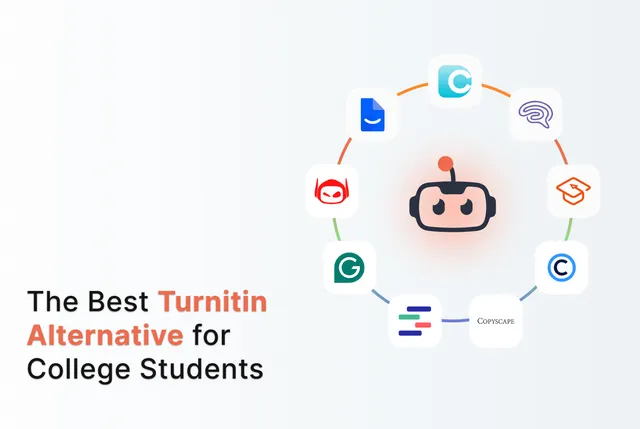
We’ve analyzed the leading plagiarism checkers like Turnitin - their features, limitations and pricing - to help educators and institutions find the one that saves both time and money. While AI misuse is rightfully raising alarm bells, relying too heavily on detectors isn't the fix. The data shows they're reactive measures that struggle to keep pace with how quickly AI is evolving. A large multi‑tool evaluation (12 public detectors, inclusing Turnitin and PlagiarismCheck) concludes that “the available detection tools are neither accurate nor reliable” and tend to misclassify AI text as human, with obfuscation (paraphrasing, translation) further degrading performance. In response, scholars argue for a strategic shift from reactive detection toward AI‑resilient assessment design that emphasizes higher‑order thinking, authentic tasks, and process‑oriented evaluation. These methods are less susceptible to automation and better support genuine learning. Edvisor is the best option to implement responsible AI in the classroom. When assessments are designed for Bloom’s Taxonomy using the teacher’s course material, the evidence of learning is more reliable.
Edvisor
Features:
- AI-resilient assignment types including oral defense of written submissions. Offers a comprehensive teaching and learning platform for higher education with AI-enabled coursepacks, assessment generation and grading tools with LMS integration.
- Features like Grade Recovery disincentivize students from taking AI short-cuts. Instead, data shows when grading is not punitive, students are more likely to make an effort and engage in productive struggle.
- Course-specific AI chat that helps students engage and achieve learning objectives efficiently.
- An extensive range of AI tools for both students and teachers.
Limitations:
- No stand-alone plagiarism detection.
Pricing:
- Free for instructors.
- Starting at $15/semester for students, replacing a textbook.
Ready to Try Edvisor?
Quetext Plagiarism Checker
Features:
- Free trial allows up to 500 words, including plagiarism and AI detection (2000 words for AI detection) as well as a built-in citation assistant.
- Clean interface and support for educators and students.
Limitations:
- The word limit for the free version is small so accessing its full capability requires a paid plan.
- Some advanced features reserved for paid tiers.
Pricing:
- Free plan covers up to 500 words and an AI detector for up to 2,000 words.
- Paid “Essential” plan for individuals begins at US $14.99/month with up to 100,000 word limit per month and extra features.
- For teams and large organisations, the “Professional” plan starts at US $29.98/month.
Grammarly Plagiarism Checker
Features:
- Includes grammar and citation assistance.
- Offers plagiarism alerts in the premium version.
Limitations:
- The plagiarism checker is not included in Grammarly’s free plan. The free version only provides minimal plagiarism feedback.
- It is less suited for in-depth academic plagiarism checks as compared to other tools.
Pricing:
- Free plan helps write without spelling and grammar mistakes.
- For individuals and teams, there is a pro version available for US $12/month with a limit of 100,000 characters per document. This also helps detect plagiarism and AI-generated text.
Copyleaks
Features:
- Supports detection of plagiarized and AI-generated content.
- Its AI and plagiarism detection tools can be made available for teachers through several LMS platforms.
- Access to all previous scan reports you’ve performed to track instances of plagiarism and AI content in student’s work over time.
Limitations:
- Offers just one free trial of 2500 words after signing up for an account.
- The downloadable report lists all the sources at the top which makes it impossible to cross-reference them with the text below.
Pricing:
- Personal plan starting at US $13.99/month for plagiarism checking and AI detection among other features.
- Pro plan starting at US $74.99/month for startups and small teams.
- Plans for enterprise and education fields available upon request.
Scribbr
Features:
- Offers deep database similarity checking including paraphrased content.
- Has a self-plagiarism checker with detailed color-coded reports.
Limitations:
- Offers a limited free version.
- Cost is per document rather than subscription based. This may make it expensive to use for students.
Pricing:
- Scribbr charges per plagiarism check depending on the word count. A small document (up to 7,499 words) costs US $19.95, a regular document (7,500 - 49,999 words) costs US $29.95 while large documents (50,000+ words) cost US $39.95.
Copyscape
Features:
- Strong for detection of duplicate content on web pages and offers plagiarism detection software to ensure originality of your work.
- Allows batch search for scanning large websites or collections of text.
- Syncs with WordPress through a plugin.
Limitations:
- No free plan available.
- You need to pay for Copyscape Premium to access the plagiarism checker.
Pricing:
- Copyscape Premium charges $0.01 (1 US cent) for every 1,000 words added to your private index, or part thereof. There is no limit on how much content you may add.
- The Copysentry Standard service checks for copies of your pages every week. It costs US $4.95 per month for up to 10 pages on your site, and US $0.25/month for each additional page up to 500 pages.
- The Copysentry Professional service costs US $19.95 per month for up to 10 pages on your site, and US $1.00/month for each additional page up to 500 pages.
Originality AI checker
Features:
- Includes credit based models to detect both plagiarism and AI-generated content.
- Provides tools to check grammar and readability.
- Offers multi-functional chrome extension and fact checking.
Limitations:
- Paid subscription or credits required for full access.
Pricing:
- One time payment option of US $30 to access the tools.
- Pro version for individuals and small teams is available for US $12.95/month.
- Enterprise version for agencies and publishers is available for US $136.58/month.
DupliChecker
Features:
- Built in grammar check, along with plagiarism and paraphrasing detection.
- Free plan allows basic scanning without storing documents.
- Suitable for small assignments and quick checks up to 1000 words per scan.
Limitations:
- Multiple ads on the interface make the DupliChecker site appear unreliable.
- Free plagiarism checker only if you want to check plagiarism in short pieces of content.
Pricing:
- Offers weekly, monthly and yearly subscription plans.
- Weekly plans range from US $5/week to US $41/week under different basic and pro options.
- Monthly plans range from US $10/month to US $200/month under several basic, pro, institute and enterprise options.
- Yearly plans range from US $110/year to US $2000/year under several basic, pro, institute and enterprise options.
Paperpal
Features:
- Allows free scanning of up to 7000 words or 25 pages per month for similarity checks.
- Compares your writing against an extensive database of 99 billion webpages.
- Offers academic translation, real time collaboration, consistency checks, pre-submission checks, AI review and in-text citations.
Limitations:
- Requires premium subscription for full unlimited access.
Pricing:
- Free for 7000 words/month of plagiarism checks.
- Prime plan available for US $11.5/month or US $139/year to unlock 10,000 words per month of plagiarism checks and full features.
Smodin
Features:
- Offers AI detection, AI paragraph rewriter, plagiarism checker and AI humanizer among other AI tools.
- Provides a citation generator as well.
Limitations:
- Only scans 1500 characters at a time on the free plan.
- Detection accuracy in some reports is comparatively lower.
- Reports are difficult to read.
Pricing:
- Ultimate plan is available for US $30/month, Reviewing plan for US $25/month and Writing plan for US $15/month with access to different features under each plan.
- For annual plans you can save 40% by getting the Ultimate plan for US $18/month annually, Reviewing one for US $15/month annually and Writing one for US $9/month annually respectively.
Why Edvisor Is the Best Turnitin Alternative for College Students
AI detectors are not infallible. There's a cat-and-mouse dynamic between AI text generation and AI detectors as they try to catch up with the AI's style of writing patterns. Turnitin showed 94% accuracy for detecting raw ChatGPT-generated texts, but only correctly identified 30% of the AI-rephrased articles. This shows that even if you subscribe and pay for AI detectors, they will still not ensure academic integrity. You need a strong Turnitin alternative for students to actually start learning.
Building academic honesty starts with a strong AI policy framework and actually designing assessments that are AI-resilient. Edvisor helps with this endeavor by encouraging responsible and productive use of AI for college students. It provides AI with guardrails for learning workflows so that students learn with curriculum-specific information and use AI for building future-proof skills.
Go Beyond AI Detection by Creating AI-Resilient Assessments
Turnitin is a helpful support tool, but it has limits. Even the best plagiarism checker struggles to keep up with the evolution of AI writing. An educator can understand nuance, intent, and authorship but AI detectors cannot. That's why, instead of trying to catch AI use, many universities are building assessments that make learning visible from the start. This means using checkpoints and reflections to show real reasoning.
With this strategy, AI isn't demonized. Students can use it, as it speeds up the process of research and brainstorming. But they need to verify everything. That means citing original sources, using their own knowledge to check outputs, and explaining their decisions in their own words.
Edvisor helps you make this shift. Our assessment formats discourage misuse while measuring true understanding. If you want practical tips and tools, subscribe to our newsletter. You'll get real examples and early access to our AI-Resilient Assessments Guide when it launches soon. Start teaching smarter with responsible AI use built right in.
FAQs
What Is the Best Alternative to Turnitin?
It depends on your specific needs. Copyleaks and Originality are good contenders for AI detection but you can explore other budget-friendly options as well. If your goal is to go beyond AI detection, check out Edvisor's AI-resilient assessment method to prevent AI cheating.
Can Professors Detect ChatGPT?
Yes, your professor can spot ChatGPT use by closely reviewing your work. AI detectors help them spot unusual writing patterns. Your tone, vocabulary, or sentence structure can be observed. Inconsistencies from previous submissions can raise red flags. AI detection software and human oversight can easily identify the AI-generated content.
What Is the Best Plagiarism Checker?
Turnitin remains the go-to choice for most academic institutions, but your ideal tool may vary based on your specific needs and budget.
How Much Does Turnitin Cost?
Turnitin does not offer individual subscriptions and its institutional subscription model is not available to the public.
What Plagiarism Checker Do Colleges Use?
Colleges mostly use Turnitin, Copyleaks or Scribbr for checking plagiarism.
What Is Most Similar to Turnitin AI Detector?
If you’re looking for a Turnitin-style alternative, GPTZero and Winston AI are often the closest match in both accuracy and features. Using both together can give you a more reliable read than relying on a single detector.
References
- Liu, J.Q.J., Hui, K.T.K., Al Zoubi, F. et al. The great detectives: humans versus AI detectors in catching large language model-generated medical writing. Int J Educ Integr 20, 8 (2024). https://doi.org/10.1007/s40979-024-00155-6
- Chechitelli, A. (2023, May 23). AI writing detection update from Turnitin’s chief product officer. Turnitin. https://www.turnitin.com/blog/ai-writing-detection-update-from-turnitins-chief-product-officer
- Giray, L. (2024). The problem with false positives: AI detection unfairly accuses scholars of AI plagiarism. The Serials Librarian, 85(5–6), 181–189. https://doi.org/10.1080/0361526X.2024.2433256
- Ibrahim, K. H. S., Al Otaibi, D., & Sibai, F. N. (2025). The robustness of AI-classifiers in the face of AI-assisted plagiarism: The case of Turnitin AI content detector. International Journal of Computer-Assisted Language Learning and Teaching, 15(1), 1–27. https://doi.org/10.4018/IJCALLT.375428
- Weber-Wulff, D., Anohina-Naumeca, A., Bjelobaba, S., Foltýnek, T., Guerrero-Dib, J., Popoola, O., Sigut, P., & Waddington, L. (2023). Testing of detection tools for AI-generated text. International Journal for Educational Integrity, 19, 1-39. https://doi.org/10.1007/s40979-023-00146-z.
- Akbar, M. (2025). Beyond Detection: Designing AI-Resilient Assessments with Automated Feedback Tool to Foster Critical Thinking. ArXiv, abs/2503.23622. https://doi.org/10.48550/arxiv.2503.23622.