

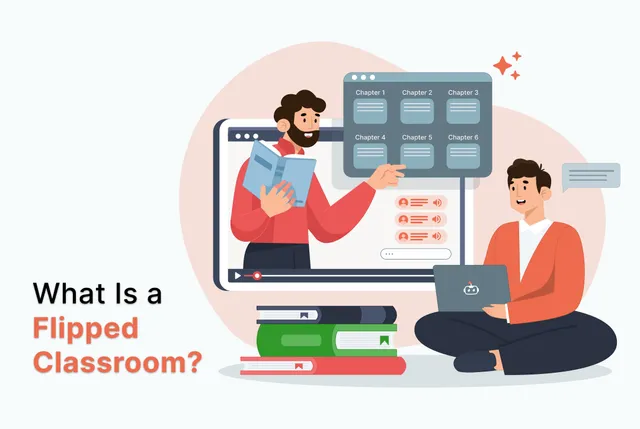
A flipped classroom is often associated with active learning as its primary purpose is to utilize class time smartly. Instead of spending your class time lecturing where students passively listen, the flipped model moves content delivery to before class. That way, when your students walk into the room, they’re ready to engage in higher-order thinking activities. Some of these activities are discussions, problem-solving, and collaborative activities. In the AI era, developing critical thinking and problem-solving is even more crucial because these are high demand skills for the modern workforce. Therefore, instructors should consider shifting from “lecturers” to “learning guides,” helping students clarify ideas, apply concepts, and think more deeply.
Implementing an AI-enhanced learning platform like Edvisor is the perfect solution to create an AI-driven flipped classroom so your students improve their AI literacy and be better prepared for the AI-native world.
In this blog, we’ll explore what a flipped classroom is and how professors can use AI to focus on building classroom experiences to integrate that learning in a practical way.
What Is the Flipped Classroom Approach?
A flipped classroom (or inverted classroom) is basically a teaching setup where students go through new material before they ever walk through the door. Maybe they watch a short video, skim a reading, or complete a small prep activity, whatever helps them show up with a bit of groundwork already in their heads. Then class time shifts into something far more lively. A flipped classroom makes students spend time on ideas and asking questions with their instructor and peers.
During the classroom sessions, the professor can assign group-based work. Students can explore case studies together, solve difficult problem sets, or participate in structured conversations that explore topics deeply.
These activities focus on application of the course material rather than its consumption. Having this kind of energy in the classroom is much more conducive for learning than content delivery.
Exploring the Different Flipped Classroom Models
There’s no one concrete formula for slipping a classroom as it can vary from class to class and course to course. Here’s how you can classify the different types of flipped classrooms, see which one suits your setting the best:
- Standard flipping: This is the classic version. Instructors record their lectures (full videos or mini lessons), and students can watch them at home before class. Class time turns into a hands-on workshop with moments of discovery and problem solving that students sort through with their instructor right there. Teachers can even bring in flipped classroom technology, like Edvisor for quick quizzes to check whether students actually followed the story in the prep material, or start a discussion thread where groups can huddle digitally and share ideas together. See our Stories to see how professors have implemented Edvisor in class.
- One-day-a-week flipping: If flipping the entire course feels like trying to renovate an entire house in one day, this is the calmer “let’s test the waters” version. Some instructors pick one day, like “Flipped Lecture Wednesday”, and drop a short prep video for students to watch. Then class becomes a lively group session where students tackle real analytical tasks, compare results, fix their own mistakes, and think aloud about how well they actually grasped the concept.
- Selected-content flipping: Choose which topics fit best in a flipped classroom setting. Teachers don’t have to create a complete video directory of lectures. Instead, focus on topics that stay the same every semester, and save your class time for fun, fresh ideas. You can tackle them in a live explanation. If there’s a recurring topic where students always get stuck, build an in-class activity around that difficult idea instead.
- Flipping without recording video lectures: A common belief is that flipping requires video but that’s optional. Students can prep through readings, slides, podcasts, animations, or any resource that gets the basic content across. Teachers can absolutely use other pre-class materials to achieve the same effect. You can achieve this easily with Edvisor which lets you create an entire coursepack within 48 hours, complete with its readings created from your material (supported by interactives, Youtube video suggestions, podcasts and diagrams) and a 24/7 available AI chat feature for students to learn with.
- Full hybrid flipping: This setup removes in-person lecture hours entirely and replaces them with asynchronous, online activities. Students spend that time reading the material at their own pace. As it changes the course structure itself, it usually needs departmental approval. For the right course, it can feel incredibly streamlined and intentional.
Why Educators Are Flipping the Classroom
Revolutionizing the traditional classroom setup is not easy but once the administrative and technological support is there, teachers can observe these flipped classroom benefits clearly:
Deeper Learning
When students walk into class already having brushed up on the basics, the whole room feels a bit different. They’re not hearing brand-new ideas, they’re building fresh layers onto concepts that are already warmed up in their minds. A study with 82 undergrad business students in a 15-week flipped course showed that doing prep work beforehand lined up with stronger feelings of learning (r = 0.31) and more growth in practical skills (r = 0.34). That early pass over the material keeps them from cognitive overload.
Self-Paced Study
Every student has their own pace to absorb ideas, and having the material ready to replay gives them comfort. They can pause and revisit the tricky bits until it finally clicks. Many students say they feel more supported when part of the course lives online because they don't feel rushed.
More Responsibility
Once students have gone over the content, students stop waiting for the instructor to directly give them instructions. They actually participate and engage with ideas to create their own learning rhythm. It encourages habits of independence and self-regulated learning that are beneficial in the long run.
Easier Peer Collaboration
With more breathing room in class, students spend actual time sharing ideas with each other. They compare approaches, swap insights, and sort through messy problems side-by-side. A flipped class can achieve the kind of shared thinking that’s nearly impossible to achieve in a long lecture.
Improved Interaction with Instructors
Educators and teaching staff get closer to the action. They wander through activities, jump in when something needs reinforcement, and spot shaky understanding long before it grows into confusion. It’s a more hands-on, human way of teaching, and of getting to know students.
Immediate Feedback
Usually, students get feedback when they submit a graded assessment but a flipped classroom allows teachers to help them spot weaknesses during a live session. When they solve problems in class, they get immediately corrected. One way you can give immediate, asynchronous feedback is through Edvisor. As the AI is already specialized on the course material , it can give students instant and accurate feedback on their scores. If the 'grade recovery' feature is enabled for quizzes and knowledge checks, they can also regain points by thoughtfully engaging in a dialogue with the AI.
Easier to Implement with Technology
With lecture recordings, short videos, podcasts, and other online materials available, students can study the content in whatever format feels easiest. They can review it at night, on the bus, or over morning coffee - it’s there whenever they need it. With AI, implementing flipped learning has become even easier and more effective. In a 6-week undergraduate computer vision course with 60 students, the AI-supported flipped classroom significantly improved academic performance, engagement, and learning strategies compared to a traditional flipped model (p < 0.05).
Ready to Try Edvisor?
Things to Consider Before Implementing the Flipped Classroom Method
Students can find it hard to start studying material on their own. Not all students are good at self regulated learning so here are some tips to get them started:
- Clarify expectations: When teachers communicate the time students should spend on each task, they can pace themselves accordingly. They should also be clear about how pre-class and in-class work connects so that they don’t get overwhelmed. Establishing these rules is important so that students understand how their preparation impacts individual and group learning
- Provide success criteria: The rubric for assessments should be clear so that students know what they will be evaluated on and focus on building those skills
- Use incentives: Give students a reward for their self-study like getting extra bonus points for pre-class work. Student readiness is essential for the success of flipped classroom activities
- Encourage collaborative learning in the classroom: Incorporate student feedback into the assignments and make this participation graded.
Flipped Classroom Strategies to Get Started
Flipping a classroom and creating a new structure can be overwhelming. Teachers often feel that preparing materials for students to study and maintaining motivation are the toughest parts of this process. Here are some useful strategies to help you take the first steps:
Start With Purposeful Class-Time Design
Choose which lessons require in-class attention and which ones should be covered at home. The entire purpose of flipped lessons is efficiency and to make sure the tougher topics are properly understood during class. When identifying topics for class time, ask yourself:
- Where do students need more guidance?
- Which topics consistently show lower performance?
- Which concepts benefit most from real-time expert feedback?
Pilot Before You Redesign
Flipping the entire course at once is not a good idea. Test the flipped model first with one class or activity. This creates some space to refine the approach and measure impact before scaling across units or the full course. Sometimes flipping the course might not even be applicable and instead, some active learning approaches might work.
Repurpose Class Time for Active, Applied Learning
Class time should focus on higher-value learning experiences that deepen understanding. Getting immediate, clear feedback can help them learn faster. Some examples of these activities are:
- Problem-solving tasks
- Peer instruction and collaborative work
- Discussions and debates
- Group projects with real-time instructor guidance
Design Meaningful Pre-Class Learning
Students must arrive prepared for in-class application. Adapt or curate content that supports this preparation, such as:
- Readings (textbooks, articles)
- Micro-lectures or educational videos
- Podcasts or simulations
How Edvisor Supports the Flipped Class Structure
Despite the benefits that a flipped classroom brings, professors still have concerns about the implementation. It's an instructional shift that has practical challenges - pedagogical, technical and logistical. Edvisor can solve all of these concerns by streamlining the teachers' workflow and engaging students at the same time.
Creating New Materials from Scratch
Edvisor is built to help professors manage this flipped classroom setup. They don't have to create materials from scratch for students to study. Our AI model takes the curriculum, existing material and learning outcomes to create readings with interactives, podcasts and Youtube video recommendations. The professor’s IP remains safe and students engage with an AI trained on their course material which is much more productive than asking a general purpose AI, like ChatGPT.
Improved Engagement
Creating accountability for students at home is a major worry for teachers. For students who don’t have strong study habits, it might risk unpreparedness for in-class sessions. With Edvisor’s interactive, course-specific AI, students feel motivated to engage and produce better results. Furthermore, the platform is FERPA compliant so it is much safer than general purpose AI that students are already using. Our recent survey reports that 86% of students felt more engaged with the content and reported a 6% improvement in grades.
Better Accountability
To create accountability mechanisms, teachers can generate graded assessments or discussion threads with peers within the platform to test their knowledge. Discussions during class could be hard to track in class and grading student responses can get complicated. With Edvisor’s AI, each student receives grading based on the depth of engagement so no more shallow responses for participation.
As all the students receive immediate AI feedback on these assessments, they can correct their misconceptions and reinforce weaker ideas. All the grading results can be integrated with the LMS as well. This clear guidance for students to engage with the material makes pre-class work simple to follow.
24/7 AI Chat Assistance
While students are studying, they stop engaging with content when they get stuck. However, with the availability of a 24/7 AI tutor built on the curriculum, they get comfortable with difficult concepts faster.
In a hybrid flipped business course in South Korea, 43 students were split into a mobile-chatbot group (31) and a no-chatbot control group (12). For students with low prior self-regulated learning (SRL), those using the “Study Buddy” chatbot improved their SRL scores by +1.81 points, while low-SRL students without the chatbot slightly declined (–0.25 points). A two-way ANCOVA showed a significant interaction between chatbot use and prior SRL level (F(1,42)=6.84, p=0.013, partial η²=0.15), indicating that the chatbot specifically benefited low-SRL students. This shows that students who even have poor study habits can benefit from the flipped learning structure if it is supported by AI.
AI Tools for Self Assessment
Edvisor gives students access to more than 30 AI tools to build subject mastery. They can generate practice questions and self assess. There’s even a debate partner tool that students can practice with - what better way to prepare students for an in-class discussion or activity.
Turn Flipped Learning Into Real Impact with Edvisor
Flipped teaching is powerful when instructors can use class time efficiently, and Edvisor is built to support that goal. Instead of spending class time delivering a long lecture, instructors can focus on building higher-order thinking among students. That way, students experience class as a place to apply ideas with guidance rather than simply listen. In this model, Edvisor’s AI takes care of the heavy lifting in the background by building readings, quizzes, and practice activities, keeping students engaged at home, and correcting them as soon as they slip off track.
Research, together with Edvisor’s own data, shows that this approach helps students learn more, participate more, and develop stronger study routines. Therefore, Edvisor offers a practical path for moving beyond one-way lectures, with complete coursepacks, smart assessments, and an always-available AI tutor that make flipped courses easier to run and sustain.
FAQs
What Is a Flipped Classroom Example?
In a flipped classroom, students watch lectures or review core content at home. Class time is used for problem-solving, group work, and debates, all with the instructor there to guide and support them.
What Are the 4 Pillars of the Flipped Classroom?
Flipped learning is a deliberate student-centered approach grounded in four core pillars: a flexible learning environment, a supportive learning culture, carefully selected content, and the active role of the professional educator.
What Is a Benefit of the Flipped Classroom?
A major advantage of the flipped classroom model is that it fosters more active, engaged, and personalized learning experiences.
References
- Wang, G. (2025). Effects of a Flipped Classroom College Business Course on Students’ Pre-Class Preparation, In-Class Participation, Learning, and Skills Development. Administrative Sciences, 15(8), 301. https://doi.org/10.3390/admsci15080301
- Han, I., Ji, H., Jin, S. et al. Mobile-based artificial intelligence chatbot for self-regulated learning in a hybrid flipped classroom. J Comput High Educ (2025). https://doi.org/10.1007/s12528-025-09434-8
- Teng, Da & Wang, Xiangyang & Xia, Yanwei & Zhang, Yue & Tang, Lulu & Chen, Qi & Zhang, Ruobing & Xie, Sujin & Yu, Weiyong. (2024). Investigating the utilization and impact of large language model-based intelligent teaching assistants in flipped classrooms. Education and Information Technologies. 30. 10777-10810. 10.1007/s10639-024-13264-z.