
AI and Academic Dishonesty: Where Educators Draw the Line
Academic dishonesty in the age of AI goes beyond plagiarism. Explore how GenAI is changing student misconduct, academic integrity, and assessment design.


Academic dishonesty still challenges the core values of education- original work, intellectual honesty, and respect for others’ ideas. Although it has always existed in higher education, in the age of AI, it has become too complex to reduce to a simple rule-breaking. Traditional modes of cheating included plagiarism, cheating, and unauthorized collaboration. These illegal practices have been defined and are easier to address, but the misuse of AI is harder to detect.
This moment asks educators to look beyond punishment and develop better pedagogy. They need to consider the fact that, as AI becomes part of the world students are entering, the real opportunity is not just to tighten restrictions. Something needs to change in the way colleges teach and assess students. That is the only way to build toward meaningful learning. If higher education institutions can use this crisis to learn and evolve, it can build stronger academic integrity.
What Is Academic Dishonesty?
Academic dishonesty is any action that does not show a student’s original work or gives them an unfair academic advantage. Some common academic dishonesty examples include plagiarism, cheating on a test or assignment, fabrication, etc. (see ‘Types of Academic Dishonesty’ below). When a student uses these methods to mislead the instructor or anyone evaluating their work for course or degree requirements, it compromises the integrity of scholarship and erodes trust in academic standards.
Since late 2022, generative AI tools such as ChatGPT have added a new dimension to this issue. As students can now use AI to produce assignments with minimal effort, many institutions have responded to address this. They have revised their academic integrity policies so that these tools support, rather than replace, genuine academic work.
History of Academic Misconduct
Academic dishonesty did not just begin with the advent of AI tools. It has existed for centuries, even in systems with strict punishments (like the 14th-century Chinese civil service exam ). In modern academia, improper authorship started becoming more visible in the 19th and 20th centuries. This is when MLA and APA citation standards began to formalize so that proper intellectual credit could be given. This is deeply concerning as it leads to serious consequences when the students enter professional lives.
Academic integrity sits at the heart of education. At its most basic level, students are taught to be honest in their work and fair in how they learn. So following ethical standards is an essential part of academic life- students should do their own work but acknowledge other people’s ideas properly when they use them.
Types of Academic Dishonesty
Higher education institutions commonly recognize these actions as academic dishonesty.
Cheating
Cheating includes seeking unauthorized help, material, or method for academic work. Cheating also happens during an exam by copying work, using notes, or tools that aren't allowed.
Plagiarism
If a student uses someone's original work without crediting their words, logic, structure, or ideas, the work is considered plagiarized. In many cases now, it can also include using AI-generated writing without permission or acknowledgment.
Fabrication and Falsification
Students cannot invent data, sources, or results in their academic work. They also can't change (falsify) or manipulate real information to make their point more convincing or stronger. Both of these actions interfere with the truth.
Sabotage
Sabotage is any intentional action that affects another person's academic work, research, or academic standing.
Multiple Submissions
Reusing an older assignment from another credit course (unless the instructor allows it), even if it's the student's own, is not permitted.
Misuse of Academic Materials
This can include mishandling academic resources. Some examples are stealing notes, using answer keys without permission, or altering academic records. Selling assignments is also forbidden.
Complicity
Helping someone cheat or participate in academic misconduct is complicity.
Lying
Lying in academia constitutes falsifying documents, misrepresenting research, or giving inaccurate information on professional profiles. This misleading information gives students an advantage, and they can gain credit unfairly without consequences.
Stealing
Stealing is taking someone else’s academic work or property without permission.
This involves academic materials like notes, assignments, research, and files. It's serious because it compromises fairness and violates ownership of another's work.
Impersonation
Impersonation is when someone else completes academic work or takes part in an exam, class, interview, or assessment on a student’s behalf. This is not their own effort, so it counts as intellectual dishonesty.
Contract Cheating
A student could arrange for a third party to do academic work for them. This often happens through ghostwriters, essay mills, or online services. As this appears as original when submitted, it is considered academic fraud.
Abuse of Confidentiality
Abuse of confidentiality happens when academic or research information (data, results, etc.) is shared without permission.
Improper Research Practices
These practices are especially concerning because they weaken the reliability of academic research itself. It includes:
- Creating false data
- Leaving out important findings
- Misrepresenting results
- Failing to cite properly
Academic Dishonesty With AI
Since generative AI tools are so accessible, it has made it easier for students to cheat in academic work. Instead of supporting learning, these tools can be used to bypass learning entirely.
- Writing tasks: These tasks require reading, thinking, and creating. Generative AI can do this for students in minutes and write full essays or research papers.
- Assessment completion: Math, coding, or other problem-solving areas are easy to solve with AI. Students are expected to work through these processes on their own by solving assessment questions, but they can plug the question in and get an answer with AI. In language courses, students may use AI to translate passages or write in another language for them.
- Exam responses: If AI is used to generate answers for take-home assignments or online exams, it does not test the student's understanding of the course material.
- Paraphrasing and rewriting: Students use AI to rewrite existing text or rework their own to bypass plagiarism detection.
- Study guides and summaries: This is not always direct cheating, but it becomes a problem when students stop engaging with the course material.
- Discussion posts: In online classes, AI can be used to generate discussion board posts and replies, so there is no way of making sure if they participated.
Causes of Academic Dishonesty
Let's look at some of the main reasons why students commit academic dishonesty instead of focusing on real learning:
- Performance pressure: Students feel stressed when there are expectations from family and peers. Not getting a certain grade could lead students to lose a scholarship. They do not just cheat due to a lack of morals. A study conducted on Chinese high school students in 2025 revealed that cheating increased under pressure and was more common among performance-oriented students. 39.7% of students engaged in dishonesty compared with 20.5% in low-pressure settings. Also, performance-oriented students showed higher dishonesty than mastery-oriented students. This is something higher education policy makers should really consider.
- Poor time management: Cheating is the last resort when students do not have time. Lack of discipline causes procrastination, so students scramble to submit work at the deadline.
- Lack of academic honesty policy awareness: An online survey of 468 undergraduate students at a Spanish university measured ChatGPT use, future-use intention, and students' perception of risk to discover the relationship between these aspects. The results showed that perceived risk was what actually motivated student behaviour. Having a good perception of legal AI use was linked to lower ChatGPT use as well as lower intention to use it in the future. So students may not avoid AI misuse because they clearly understand the risks and boundaries around its use. All students should know their institution's academic integrity policies.
- Technological ease: Having easily accessible plagiarism avenues like Generative AI or contract cheating makes it very easy for students to outsource their work. Due to this, it’s very important to rethink how AI use is incorporated into the learning and assessment process. If you’re lost on how to get started with this process, our AI-resilient assessment guide can help you diagnose the issues in your assessments. Figure out the task vulnerability - then plan where to allow AI, where to ban, and where to allow partial use. You’ll find detailed tables with tasks from every discipline in this Guide and how to update them for AI-resilience. You can also find the AI declaration form in this Guide to make this process easier and start making students aware of responsible AI use.
Why Is Academic Honesty Important in the Age of AI?
Academic honesty matters even more now in the age of AI, as AI poses real threats to real learning. In order to maintain people's faith in qualifications, it is important that universities help students build critical thinking and ethical judgment. Researching, writing, and problem-solving prepare students by developing the skills they need in the real world. AI and academic integrity are a challenge for higher education, as it has taken away trust in assessment and fairness.
In summer 2025, College Board surveyed more than 3,000 U.S. college faculty and found that overall sentiment toward AI leaned negative. About 45% said they viewed AI negatively in higher education, compared with 34% who viewed it positively(only 77% had used AI in their professional role).
For personalized explanations of difficult concepts, faculty endorse AI. Still, the concerns were much stronger than the optimism. More than 84% of faculty said AI affects students’ critical thinking and originality. They also stop engaging deeply with the course content. Academic integrity is at risk, as 92% worried about AI plagiarism.
Managing student AI use is now a challenge for most instructors. Only 21% felt very confident guiding AI use in class, and many reported that institutional policies and support are still inconsistent. Let's explore how professors can use AI tools for preventing academic dishonesty.
Edvisor is now available in your bookstore for just $25.
Building AI-Resilient Assessments to Mitigate AI Cheating
So how can students avoid academic dishonesty when AI makes it so easy to cheat? There is a need for core changes in the way courses are taught and knowledge is checked. Teachers use AI detectors and address incidents, but these practices don’t build mastery for all students. As mentioned above, shortcuts have always been around, but new policies and practices have created stronger learning pathways. Let’s look at some research-backed ways to bring back academic integrity through smarter assessments:
Why We Need Course-Bounded AI for College Students
Course-bounded AI tools like Edvisor bridge the gap between academic integrity and AI adoption. Using generic AI, student use is unbridled and also causes confidential data leaks. These tools still can’t compute spreadsheets properly, so students can produce misleading results, as many students are still not good at verifying outputs. Professors need to make sure that the knowledge they study is curated by them or the institution.
AI Detection Tools Can’t Define Ethics of AI in Education
Many universities are providing frameworks to address AI cheating by first collecting evidence and then having an open dialogue with the student. AI detectors can create false positives or negatives (when students use bypassers or humanizers). This creates an environment of constant vigilance, which is not conducive to learning. A 2025 comparison of the most commonly used AI detection tools revealed that the newer deep learning tools, like Copyleaks, had a better detection rate (92%, compared to Turnitin's 40% and Grammarly's 30%) but that came with an 8% false positive rate. This led to 43% of educators getting discouraged from using it, as it flags innocent students. What’s more important is connecting learning goals and assessments.
What Authentic Assessments Look Like
To address over-reliance on AI, alternative academic assessments are emerging as a promising solution. Traditional assessments are memorization-based and need to be more process-oriented. If you're looking for a platform that can help you deliver these assessments fast without your course material being used to train generic AI models, Edvisor can give you the perfect workflow for it. To help you explore these AI-resilient assessments, we have created a detailed guide on redesigning assessments for AI use in college.
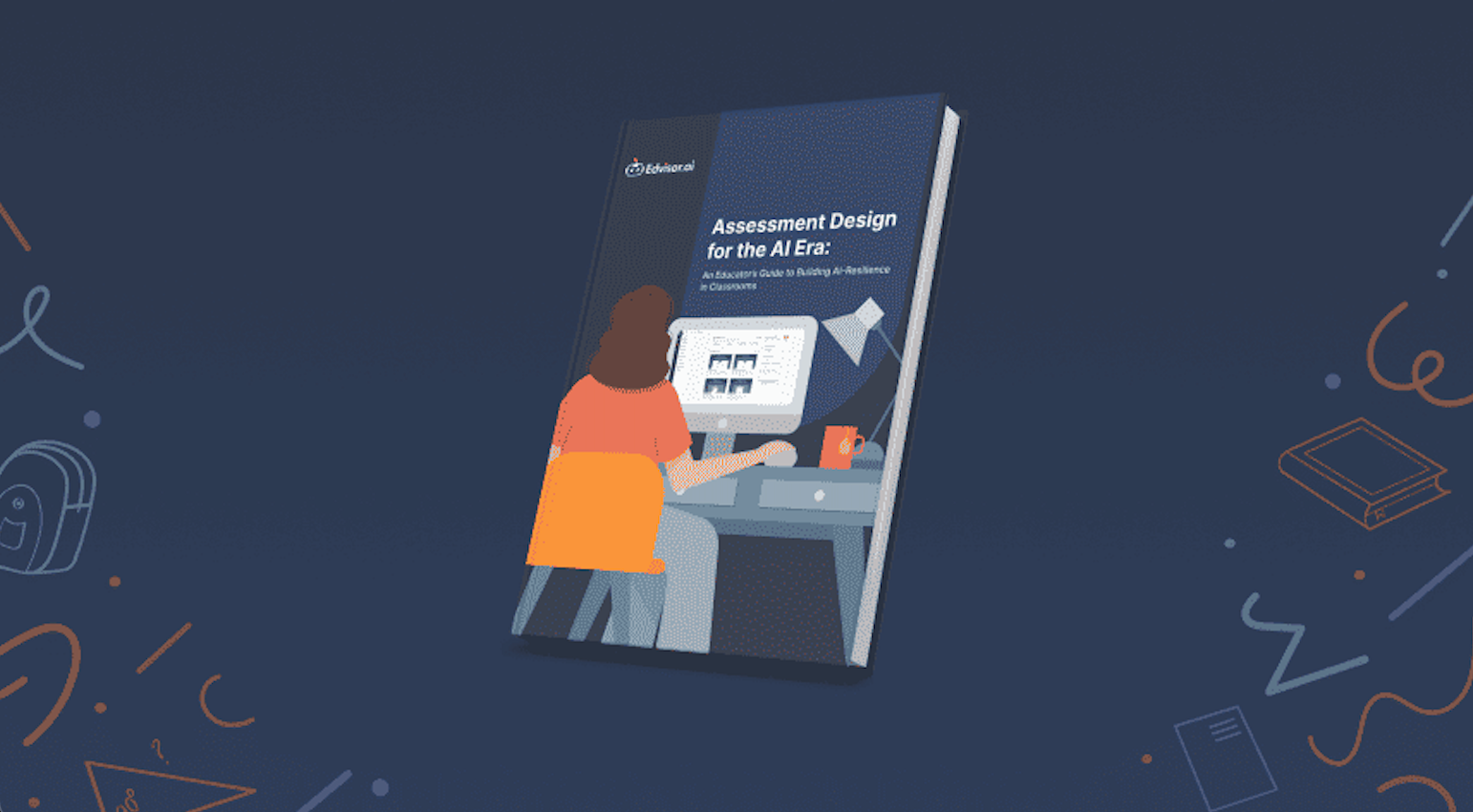
Explore practical ways to make assessments AI-resilient
How Edvisor Supports Academic Integrity by Design
At Central Queensland University, an intervention used a students-as-partners model which embedded integrity guidance into Moodle. It provided standardized support across and delivered mobile-friendly resources through blended learning. As a result of this, in BUSN 20017, breaches fell from 523 cases in 2018 to 63 in 2019. Misconduct prevention works when students are supported early, and expectations are visible. Edvisor supports this kind of integrity by design through the following features:
- Scaffolded assessments that capture the student's thinking process and grade them accordingly
- Oral defense feature to record student responses immediately after text submission, which makes submissions AI-resilient
- Discussion threads to encourage participation, and grading is done on the basis of depth of response
- AI-assisted readings that encourage engagement with the course material and assist in true mastery
- Grade recovery feature that discourages cheating and instead provides students a chance to recover points by demonstrating subject mastery
Start Addressing Academic Dishonesty With AI in Higher Education
Universities don't need stricter rules to control AI misuse. Let's make integrity easier to practice and harder to bypass by creating new learning environments. Edvisor stands out by helping professors support authentic assessments and protecting their intellectual property. It gives educators a practical way to build AI-resilient teaching while building student accountability.
Citations
- Xia Yin, Qinjiang Lai & Yi Guo (2025) Drivers of academic dishonesty: situational pressures versus student motivation, International Journal of Adolescence and Youth, 30:1, DOI: 10.1080/02673843.2025.2560649
- Ortiz-Bonnin, S., Blahopoulou, J. Chat or cheat? Academic dishonesty, risk perceptions, and ChatGPT usage in higher education students. Soc Psychol Educ 28, 113 (2025). https://doi.org/10.1007/s11218-025-10080-2
- College Board. (2026, February 25). New College Board research: Faculty express near-universal concern that student AI use undermines original writing and critical thinking. College Board Newsroom.
- Leong, W. Y., & Zhang, J. B. (2025). AI on academic integrity and plagiarism detection. ASM Sci. J, 20, 75.
Frequently Asked Questions
What Are the Four Types of Academic Dishonesty?
The four main types of academic dishonesty fall under these categories:
- Cheating.
- Plagiarism.
- Fabrication or falsification.
- Sabotage.
Is Using AI Considered Academic Dishonesty?
Yes, when AI use violates specific course policies and AI-generated content is submitted as one’s own.
Can Academic Dishonesty Affect Your Career?
Yes, it can cause long-term professional damage. Your career could be affected if your professor fails you in modules. Sometimes it can result in suspension or revoked degrees.
How Long Does Academic Dishonesty Stay on Your Record?
Severe and repeated cases can stay on the permanent record and cause problems in getting professional licensing and the graduate application process. Suspension and expulsion do stay on your record permanently.
Does Academic Dishonesty Go On Your Transcript?
Yes, it stays on your transcript.
What Happens if You Are Accused of Academic Dishonesty?
Academic dishonesty consequences range from a zero on the assignment or failure of the course. If it’s a major misconduct, it could result in suspension or expulsion.
Has AI Increased Academic Dishonesty?
According to College Board February 2026 AI survey, more than 84% of faculty agree that AI can reduce students’ critical thinking, originality, and deeper engagement with course material. Another 88% are concerned about students becoming too reliant on automation.
Academic integrity is also a major concern. In fact, 92% of faculty worry about plagiarism or dishonesty made easier by AI.


