

Inquiry-based learning encourages curiosity and critical thinking. In today's AI-driven academic landscape, it is even more relevant now. AI has changed how students access information and how educators design instruction. Universities are reevaluating what meaningful learning really is. This blog explores what inquiry-based learning is and why it is crucial in developing a workforce for the AI-first world. We'll look at how AI, when used responsibly, can strengthen inquiry-based teaching and also the challenges that come with its use.
What Is Inquiry Based Learning?
Inquired based learning encourages students to explore questions and scenarios instead of finding one solid answer. This makes them move beyond absorbing facts and towards natural curiosity. When they get into this habit of investigative learning, they can analyze and build understanding through discovery. The teacher becomes a facilitator instead of a primary source of correct answers.
Some inquiry-based learning examples include science experiments, case studies, classroom debates, problem based projects and field trips. In all of these cases, students build their hypotheses and test them through the data they get from exploration.
Understanding the Inquiry Cycle
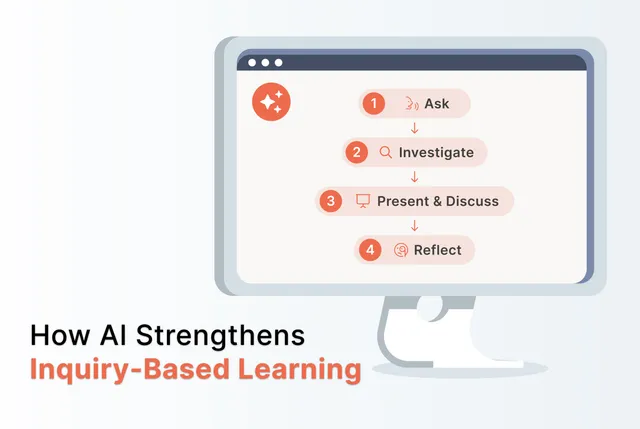
The inquiry cycle is an adaptable, iterative framework. It supports learners in examining ideas, asking questions, and developing solutions through guided exploration. For a structured learning experience, it is important that professors guide the student's curiosity. To help them navigate the problem or scenario, there are four main steps of the process of inquiry in higher education:
- Students generate meaningful, discipline-aligned questions: Instead of starting with predetermined answers, students create their own queries for exploration. Professors encourage them to write a clear problem statement that's significant in the field. They should be able to support it by initial reasoning, gaps in existing research, or citations from course readings. This step helps them take ownership of the learning process while grounding their inquiry in academic rigor.
- Students investigate the question through guided research: The professor is the expert on the subject matter so students' exploration should happen during their presence. This helps them refine research strategies and use deeper analytical inquiry.
- Students present what they’ve learned: In university settings, the final product can be a research brief, a presentation, a case study analysis, or even a small digital project. The important thing is for students to be able to teach back their understanding. The professor's rubric helps clarify expectations around depth, clarity, and academic integrity.
- Students reflect: Reflection is essential in higher education because it reinforces metacognition, or students’ ability to evaluate how they learn. Ask them to consider questions like: What research strategies worked? Where did they struggle? How did their understanding evolve?
Types of Inquiry
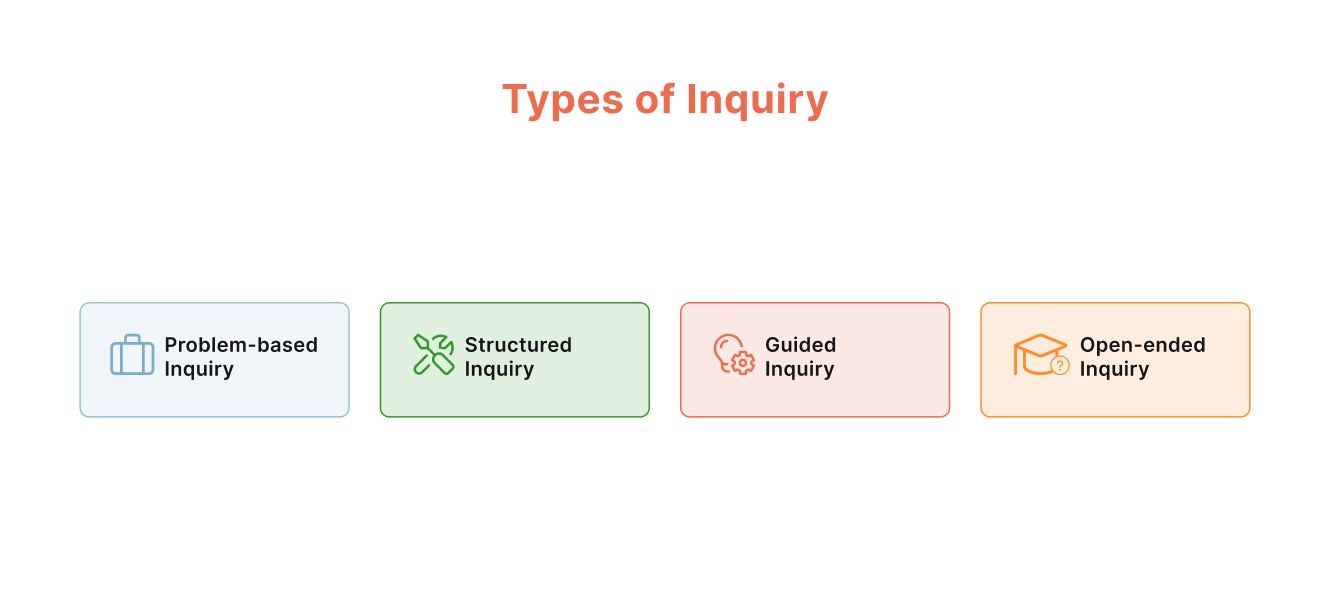
When students see a problem, they start with a blank page. Professors guide their inquiry process using the following approaches:
- Problem-based inquiry: Students apply the course concepts they've learned to real-world problems. This makes them come up with practical and evidence-based solutions while building their problem solving skills.
- Structured inquiry: The professor provides both the guiding question and the method of investigation (the primary structure). Students analyze, interpret, and draw conclusions within this framework. This works when professors want to model disciplinary research methods.
- Guided inquiry: Guided inquiry involves more instructor support and is ideal for complex concepts. It is typically used when learners are developing foundational inquiry skills. The prompted questions help them design investigations while they work through their reasoning process.
- Open-ended inquiry: This is the most independent inquiry-based approach, as the open-ended inquiry gives students full autonomy. It works well for advanced learners and capstone projects. By exercising their creativity and deep learning, they generate their own questions and design their investigative approach. After this, they also interpret their findings.
Benefits of Inquiry Based Learning
Inquiry based learning makes the motivation to learn more intrinsic instead of imposed so the classroom becomes a dynamic learning environment. As students understand the course topics, they also build confidence and other essential skills:
- Critical thinking: Questioning and verifying information makes students exercise their critical thinking. Instead of accepting ideas at face value, they evaluate sources and identify fallacies. Real world challenges are complex and open ended problems help them develop the analytical skills needed to tackle them.
- Problem-solving skills: Memorized answers don’t solve open-ended questions. As students test ideas, they build independence and creativity which are essential for their careers.
- Curiosity: The inquiry method sparks curiosity by making students create their own path to learning. Through questions, investigation, and reflection, they understand material and build academic engagement in a meaningful way.
- Active learning: Experimentation and discussions make learning less passive. Metacognitive skills build as they participate in hands-on learning and connect concepts.
- Creativity: When answers aren’t obvious, students have to get creative. They experiment with ideas and consider multiple perspectives to look for a new idea to handle challenges.
- Research skills: It naturally develops strong research skills. Developing information literacy means finding credible information and evaluating evidence. This is how students learn how to analyze and synthesize complex ideas which translates to real-world success.
- Higher engagement: Students don’t just take notes, they activate their curiosity. This makes them more attentive and encourages deeper participation. A sense of ownership is built which keeps them invested to figure out their answers.
- Communication skills: Group projects teach them to articulate their thinking clearly while listening to diverse perspectives.
Why Is Inquiry Based Learning Important in the Age of AI?
The inculcation of inquiry-based learning in higher education is more important than ever due to the emergence of AI. Ethical and effective utilization of AI requires critical thinking. Therefore, students need to develop this nuanced thinking to navigate the use of AI in their life and jobs.
Prepare Students to Adapt in an AI-Driven World
As higher education grapples with the Industrial Revolution 5.0, students must learn to have a deep understanding of technology. 1 AI dominates every aspect of our lives and students should not be alienated. They should be taught how to use it effectively and adapt. 2 Building AI literacy and learning responsible AI use is important to prepare students for the AI-first world.
Strengthen Higher-Order Thinking
It’s very easy to get answers through a simple search but that leads to cognitive laziness (a.k.a. “brain rot”) among students. In order to counteract this passive acceptance of AI outputs, inquiry-based learning is essential. Answers from ChatGPT and other LLMs cannot be entirely trusted; students should be able to critically discern the outputs by using inquiry. 5 They must be able to understand how to effectively question and cross-check the information and ideas they get from the AI.
How AI Supports Inquiry-Based Learning
The AI-assisted inquiry-based learning model supports learners in three ways:
- Personalized pathways
- Real-time feedback
- Dynamic assessment
Students also feel more confident with self-directed inquiry as they overcome that initial hesitation to ask questions. Unlike traditional inquiry that often depends heavily on textbooks, this approach offers faster feedback. During assessment, AI delivers continuous feedback and adaptive evaluations of progress are trackable. Teachers can adjust learning strategies as needed, rather than relying only on final exam scores that capture performance too late. 2
Here are some of the ways in which AI is elevating inquiry-based learning:
Personalized Learning Paths
AI adapts content and challenges according to the pace and interests of the student. This creates custom learning journeys which makes the process of asking questions easier. In a 2024 study, a teacher used AI to transcribe real English audio and adapted the content into inquiry-based learning activities. She was able to create authentic and level-appropriate materials for students in a much shorter time. These materials were much more engaging and resulted in a more active participation. 3
Idea Exploration
Students approach problems from new angles during inquiry learning and AI is the perfect exploration partner to do that. Inquiry learning requires a self-directed, project-based approach. AI guides students through this process and adjusts according to the context. It provides students rubric-aligned feedback and helps them refine their projects. Having this support helps them think critically about the project and their own learning journey. In design education, AI and inquiry-based learning make students move out of their fixed thinking patterns. They ask better questions and can therefore come up with newer ideas. 4
Synthesis and Analysis
Using an AI-powered scenario or simulation, they can explore the fairness of different outcomes. For example, they can ask AI to present contrasting cultural perspectives and then analyze them. This comparison helps them spot bias and discuss viewpoints in class.
Real-time Feedback
The iterative nature of inquiry based learning requires feedback. While teachers cannot be present 24/7 for this, AI can provide immediate feedback to students. When students have this corrective feedback in their independent investigation stage of inquiry learning, they can understand concepts better.
Developing Communication Skills Through AI-Enabled Inquiry
Having AI as a learning partner helps students practice real-world conversations. Asking better questions, listening to alternative viewpoints, and adjusting their responses. AI is an effective innovation to help students develop the speaking and listening skills they need to strengthen their arguments. 3
Lesson Plan Generation
Integrating AI into university-level curriculum design can help professors strengthen inquiry-based learning across disciplines. When AI acts as a co-designer for creating interactive material for students, it can save professors' time. The material is much more engaging as AI can support personalized inquiry prompts and adaptive activities for inquiry-based lessons. It changes the role of teachers from mere executors to instructional architects who only need to clarify their teaching objectives to command the AI to refine the learning tasks.
Challenges of Using AI in the Inquiry Based Learning Model
- Cognitive over-reliance: Students can lose their independent thinking when they start over-relying on AI. This overdependence can cause them to lose their ability to engage deeply in inquiry and developing higher order reasoning. 2
- Data privacy risks: Institutes need to comply with data handling rules as students need to know if their data is private. Using AI for learning can threaten learner trust if general purpose AI is used. 6
- Transparency, accuracy, and trust in AI outputs: Teachers need to know whether AI outputs are accurate and unfabricated. It is difficult to know this with proprietary AI models due to their opaque nature. This uncertainty can also undermine students’ ability to evaluate sources.
Edvisor solves all these problems by addressing the pedagogical and institutional concerns behind AI use. Since the AI is trained on the teacher’s own curriculum and material, the AI outputs are not vague and fabricated. Teachers can easily share their knowledge and students can engage with verified content, knowing their data is safe and not being used to train models. The way students interact with the AI during assessments makes them learn instead of getting the answer right away. For example, for the ‘Discussions’ feature, which is a crucial part of inquiry-based learning, students get feedback on the depth of their answer which makes them participate more. The AI does not give them the correct answers as soon as they are wrong or disengaged, it supervises them to learn better.
Ready to Try Edvisor?
How Edvisor’s AI Enhances Inquiry Based Teaching in Higher Education
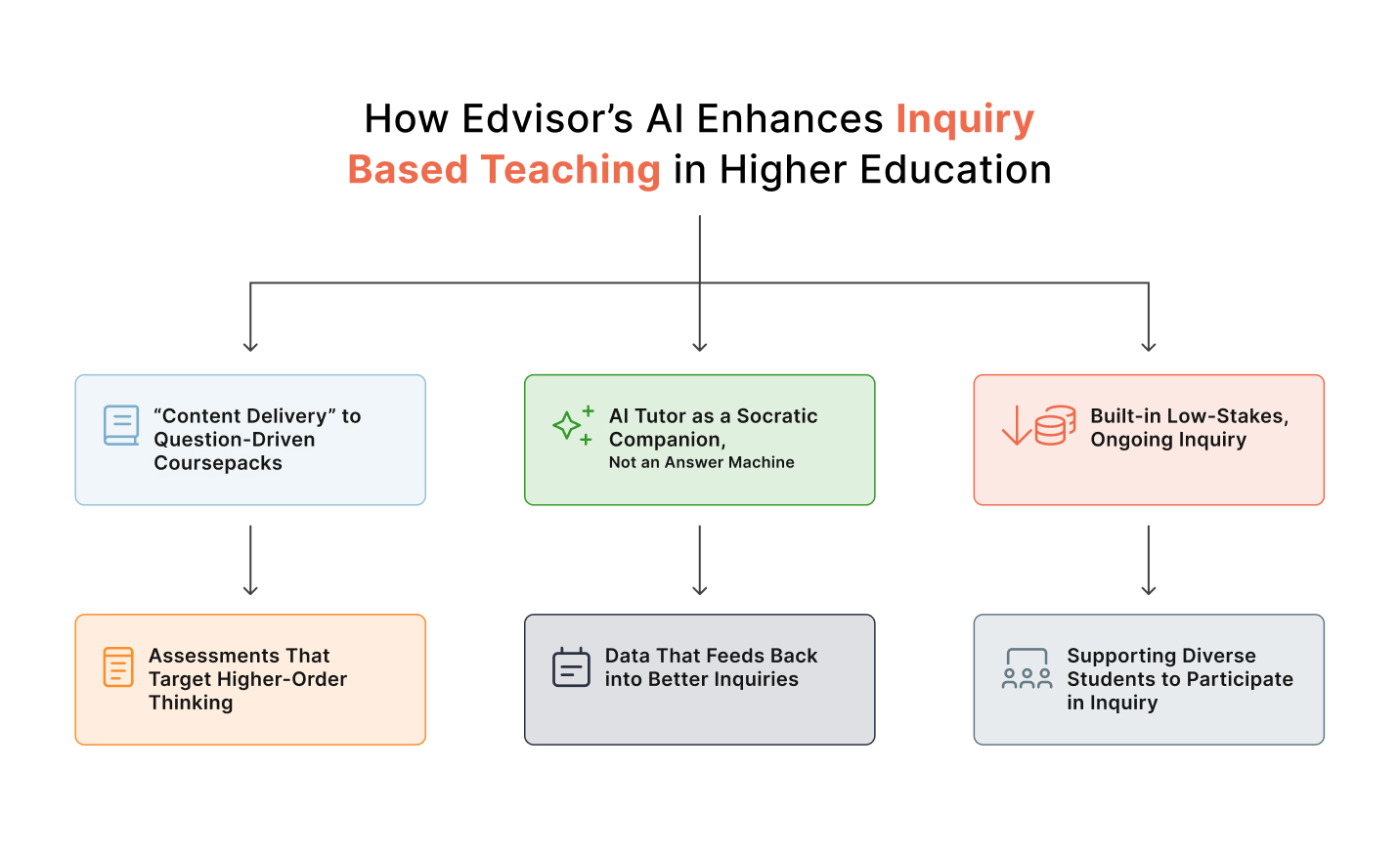
Edvisor’s AI coursepacks are designed to responsibly use AI in higher education. Having an AI trained on learning outcomes (which can be aligned with inquiry-based learning) makes it an ideal inquiry-based instruction partner for professors. Here’s how Edvisor’s features support inquiry-based learning:
“Content Delivery” to Question-Driven Coursepacks
Instead of just pushing readings, Edvisor lets professors frame modules around big questions and problems. When learning outcomes and syllabus are used as input, readings, quizzes, and discussion prompts are automatically aligned. When designing the course, the professor can write prompts as inquiry tasks (e.g., outcomes starting with “Compare”, “Critique”,etc) to make an inquiry-based curriculum. This way, Edvisor's AI coursepack itself becomes an IBL scaffold, not just a digital textbook.
AI Tutor as a Socratic Companion, Not an Answer Machine
Edvisor’s AI assistant is trained only on the professor’s material, so students are nudged to:
- Ask follow-up questions when they get stuck reading course content (learning through inquiry)
- Get clarifications, hints, and counterquestions rather than direct “finished answers”.
- Use grade recovery to earn back points by explaining their reasoning more deeply.
That’s classic inquiry: probe, refine, justify, instead of copy-paste from a general LLM.
Built-in Low-Stakes, Ongoing Inquiry
Edvisor bakes inquiry into the everyday flow of the course:
- Reflection questions at the end of readings.
- Practice questions and micro-assessments tied directly to course concepts.
- Discussion threads where students must defend interpretations, evaluate cases, or apply theories.
This turns learning into a continuous ask-test-reflect loop rather than a couple of high-stakes exams.
Assessments That Target Higher-Order Thinking
Because assessments are generated from the syllabus and learning outcomes, professors can:
- Specify analysis, evaluation, and creation-level tasks (not just MCQs).
- Mix formats (short answer, essay-style, case analysis, compare/contrast, etc.) that naturally support inquiry.
- Use AI to draft questions, then human-edit them to make them more context-rich, local, or authentic.
In other words, Edvisor helps teachers design inquiry-friendly assessments. There are also AI tools within Edvisor like Text Scaffolder, Unit Plan Generator, Lab Exercise Generator, Real World Connections and Groupwork Generator, that can help them create inquiry learning tasks for students.
Data That Feeds Back into Better Inquiries
With Edvisor’s analytics, professors can see:
- Where students are consistently confused.
- Which questions or readings generate more engagement.
That data can be used to refine future prompts, rethink tasks, and design new inquiry paths (e.g., new case studies, additional comparison questions) based on how students actually think.
Supporting Diverse Students to Participate in Inquiry
Because readings are multimodal (text and media) and the AI tutor is always available:
- Students who need more time or different explanations can still engage with the inquiry, not just memorize.
- The system lowers the barrier to asking “basic” questions, students can test ideas with the AI, then bring better, more refined questions to class discussions.
Empower Your Students with an AI-First Learning Approach
Inquiry-based learning teaches students critical thinking, creativity, research literacy and communication. Through this engaging process, students are not just consuming information, they explore and reflect. Instead of using AI for quick answers, students can use AI to question assumptions, analyze evidence and build knowledge through inquiry. AI is a powerful ally for inquiry-based learning as it can support this exploration and provide real time feedback. For professors, it can help with richer instructional design and adaptive inquiry experience. At the same time, responsible implementation is essential so that data remains safe and students don't over-rely on AI outputs.
This is where Edvisor stands apart. By training AI directly on a professor’s own curriculum and verified academic content, Edvisor preserves pedagogical intent. It safeguards student data, and keeps inquiry at the center of learning. Edvisor transforms inquiry-based learning from a teaching philosophy into a practical, scalable reality for higher education. Question-driven coursepacks, Socratic AI tutoring, actionable analytics all help create authentic thinking.
FAQs
How Does Inquiry Based Learning Benefit Students?
Inquiry-based learning helps students think deeply and solve problems creatively. Learning gets more engaging as students explore questions which strengthens their research and communication skills.
What Are the Disadvantages of Inquiry Based Learning?
The main disadvantage of implementing inquiry based learning is that students can’t see when they are wrong. The need of immediate feedback is important. Edvisor solves this problem by giving students the support they need during inquiry learning through its 24/7 available AI tutor.
What Are the Elements of Inquiry Based Learning?
Key components of inquiry-based learning include:
- Curiosity-driven questions
- Research/investigation
- Critical thinking
- Collaboration
- Deep reflection
Citations
- Pérez-García, M., López-Martínez, J., & Hernández-Rodríguez, R. (2025). Inquiry-Based Learning and Critical Thinking Skills of Higher Education Students in the Era of Revolution 5.0: A Meta-analysis. Cuestiones de Fisioterapia. Advance online publication.
- Zhou, G., & Huang, J. (2023). Generative inquiry-based learning: New models of AI-empowered education. In Proceedings of the 2023 International Conference on Advanced Learning Technologies (pp. 1–6). ACM.
- Yeh, H. C. (2025). The synergy of generative AI and inquiry-based learning: transforming the landscape of English teaching and learning. Interactive Learning Environments, 33(1), 88–102.
- Tseng, TN., Lee, TM., Kuo, JY. (2025). Enhancing Inquiry-Based Learning in Human Factors Engineering with Generative AI: A Case Study in Industrial Design Education. In: Smith, B.K., Borge, M. (eds) Learning and Collaboration Technologies. HCII 2025. Lecture Notes in Computer Science, vol 15808. Springer, Cham.
- Li, P.-H., Lee, H.-Y., Lin, C.-J., Wang, W.-S., & Huang, Y.-M. (2024). InquiryGPT: Augmenting ChatGPT for Enhancing Inquiry-Based Learning in STEM Education. Journal of Educational Computing Research, 62(8), 1937-1966.
- Degen, B. (2025). Resurrecting Socrates in the Age of AI: A study protocol for evaluating a Socratic tutor to support research question development in higher education. arXiv.