

Webinar Recording - Why Are Students Upset About AI: A Student & Professor in Conversation
Why are students angry about AI? Watch a student and professor discuss cheating, critical thinking, and trust in higher ed.


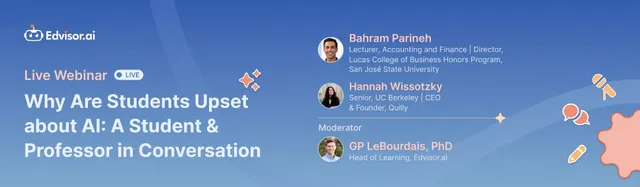
Student AI protests are more complicated than simple resistance.
In this conversation, Bahram Parineh of San José State University and Hannah Wissotzky of UC Berkeley join Dr. GP LeBourdais of Edvisor to explore what students are really responding to when AI enters the classroom. Behind this AI anger, there's uncertainty, academic trust, career anxiety, and the fear that technology may replace the hard thinking that education is meant to develop.
Let's move beyond AI hype and student AI panic to ask more practical questions about AI and higher education in the United States. Dr. Bahram shares how faculty can use AI in ways that support learning without letting students skip the learning.
Key Takeaways From the Conversation
- Students are not necessarily anti-AI. They are worried about what AI is doing to learning. The concern is not simply that students reject the technology. Many students use AI and expect to use it in their future careers. The deeper issue is trust: students are worried about whether AI is changing the value of their learning, their effort, and their degree.
Bahram Parineh captured this clearly: “Students are pro-learning. The depth is still worth something. It’s not made worthless by AI. It’s the shallow answers that are made worthless.” - Faculty need to be transparent about AI use, not just restrictive.
Bahram emphasized that trust begins with honesty. If faculty use AI to design assignments, generate examples, or support teaching, students should know that. In return, students should also be expected to disclose when and how they use AI. - The real challenge is assessment design.
The conversation repeatedly returned to one point: better AI detection is not enough. Faculty need better assignments.
In finance and accounting, Bahram described how AI can separate the right answer from real understanding. A student may produce the correct number without knowing the machinery behind it. His response has been to shift assessment toward explanation, prompt history, unique inputs, error-finding, and short oral defenses that ask students to show their reasoning. - Students feel pressure to use AI when they believe everyone else is using it.
Hannah described the student-side tension clearly. Even students who care about learning may feel pressure to use AI if they believe their peers are using it to move faster or get ahead.
This creates an arms race problem: students may not want to outsource their thinking, but they also do not want to feel disadvantaged. That is why clear classroom norms matter.
Hannah’s strongest point was that there are moments when AI can speed up a task, but students still need to practice the underlying skill. She described choosing not to use AI for some strategy work because she knew she needed to learn how to think through the task herself. - Higher education’s goal is judgment, not just content delivery.
Near the end of the conversation, Bahram framed the broader shift clearly: “Higher education was always about building judgment, not delivering content.”
If AI can generate answers quickly, then the scarce skill is no longer simply producing output. It is knowing when to use AI, when to question it, when to leave it out, and how to judge whether an answer can be trusted.
“Students are pro-learning. The depth is still worth something. It’s not made worthless by AI. It’s the shallow answers that are made worthless.”
— Bahram Parineh, Lecturer in Accounting and Finance, San José State University
Frequently Asked Questions
Why Are Students Booing AI?
Students are pushing back against AI because they're uncertain about its impact. They are worried that automation is changing the job market and that creativity is dying. Pro-AI speeches can also feel insensitive. This is especially true when students are preparing to enter an uncertain economy while executives focus on AI’s efficiency and business benefits.
Why is AI a bad thing for students?
AI can weaken student learning when it encourages cognitive offloading (using chatbots to complete work without practicing the thinking behind it). As discussed in the webinar, the risk is not AI itself, but letting students “skip the learning.” Overreliance can reduce critical thinking, problem-solving, information retention, and independent judgment. It also exposes students to misinformation and bias.
Why does Gen Z hate AI?
Gen Z’s frustration with AI is growing. Many worry it could replace jobs, flood the internet with low-quality “slop,” and make human creativity feel less valued. There are also concerns about the environmental cost of the data centers powering these tools.
Why are some professors so worried about students using AI for their assignments?
Professors worry about student AI use because it can blur academic integrity, weaken critical thinking, and produce inaccurate or fabricated information.
Realistically, AI can make it easier for students to submit work that is not fully their own. It can also let them skip the reasoning and struggle that real learning requires.
How can faculty build trust around AI use?
They need to be transparent about how they use AI, explaining when students can or cannot use it, and connecting those expectations to learning goals. Trust improves when AI policies are framed around learning, not just detection.
What should students learn in an AI-supported classroom?
Students still need subject matter expertise. Students cannot evaluate AI outputs they do not understand. AI may change the workflow, but students still need to build the judgment to know when AI is useful and when it should be left out.


