

Webinar Recording: AI and Education- Sparking Innovation When Policy Remains Unclear
AI is becoming part of everyday education while institutional policy struggles to keep pace. Join David Fu to explore what comes next.


AI policies are still taking shape, but higher education cannot put every decision on hold until the rulebook is finished.
In this conversation, David Fu, Lecturer in Penn GSE’s Education Entrepreneurship M.S.Ed. program and Founder and CEO of Learning By Design AI, joins Edvisor’s Director of Product & Learning, GP LeBourdais, PhD, to discuss what responsible innovation can look like when formal guidance is still evolving.
Drawing on David’s work with education organizations and his own informal experimentation with students at Penn GSE, the conversation moves from classroom-level AI rules to ethical considerations of AI in education, data privacy, institutional procurement, co-design, equitable access, and how colleges can move from a focused pilot toward responsible implementation at scale.
“Lead with the use case, make sure you're leading and building with it yourself... but also make room for experimentation informally as well.”
-David Fu, Lecturer, Penn Graduate School of Education; Founder & CEO, Learning By Design AI
(~50:07–50:20)
Key Takeaways From the Conversation
1. AI policy needs both firm institutional rules and room for faculty judgment
David distinguishes between hard policies and soft policies.
Hard policies cover areas institutions need to codify carefully, including security, privacy, legal requirements, and other institutional safeguards. Soft policies can give faculty more flexibility to determine what appropriate AI use looks like in a particular course or assignment.
One model discussed is a green, yellow, red framework: AI can be broadly permitted in one context, allowed within specific constraints in another, and prohibited where the learning objective requires students to work without it.
(~12:43–13:52)
2. Allowing AI does not mean removing responsibility from students
In David’s project-based Penn GSE course, students are generally encouraged to use AI, but they are expected to disclose how they used it.
The distinction matters because AI can now produce polished venture cases, presentations, prototypes, and other outputs very quickly. David argues that the real question sits underneath that surface: can the student explain the reasoning, substance, and learning behind what they submitted?
That is where authentic and oral forms of assessment can help instructors see what students actually understand.
(~15:24–17:10)
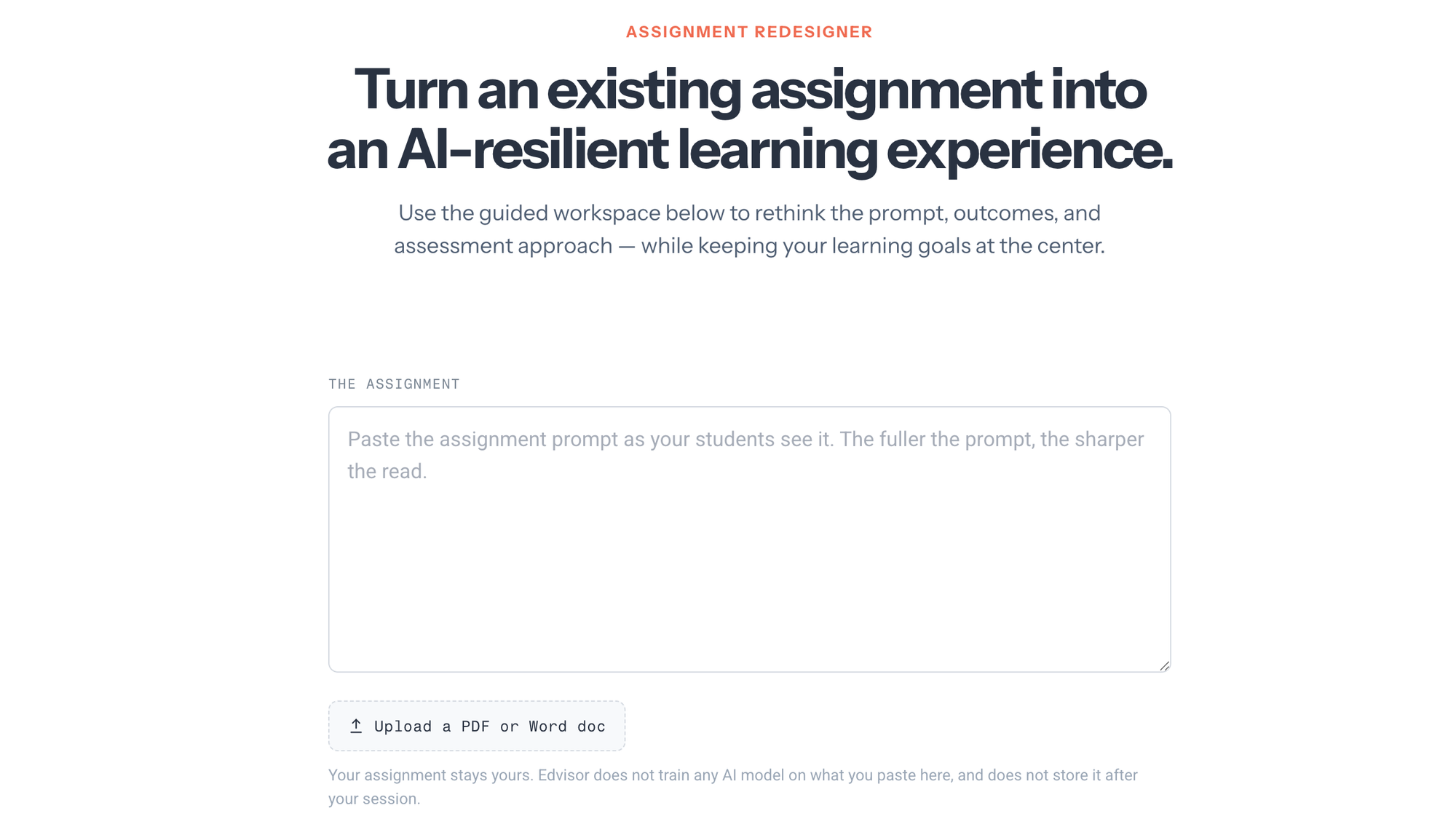
Try Our Free Research-Backed Assessment Redesigner
3. Existing AI policies can become outdated before institutions finish implementing them
The conversation examines the difficulty of creating long-lasting institutional policy for technology that is moving from chat interfaces toward increasingly agentic and autonomous systems.
David discusses how a policy built around AI as a system that generates information for a human to review may not adequately account for tools that can take actions across other systems and workflows.
The implication is that AI policy cannot be treated as a document institutions write once and leave untouched. Governance has to evolve alongside technological capability.
(~22:27–26:57)
4. Start AI implementation with one problem, not an institution-wide platform
When GP asks where a university should begin, David’s recommendation is straightforward: start small and start intentionally with a specific use case.
That use case could sit within teaching and learning, student success, admissions, enrollment, career services, or institutional operations.
The purpose should come first. Only after identifying the problem should a team determine what AI capability and what data are actually required to solve it.
(~29:21–30:19)
5. New AI experiments should not begin with unrestricted access to live institutional data
David recommends starting with a copy of the relevant data rather than immediately connecting an experimental AI system to the live source.
Teams can identify the minimum amount of information necessary, anonymize it, remove personally identifiable information, and establish appropriate privacy and FERPA safeguards before experimentation begins.
From there, institutions can test one step at a time and keep humans involved at points where judgment or exceptions still matter.
(~30:19–33:04)
6. AI procurement needs to become more iterative
GP and David question whether traditional software procurement cycles are well suited to AI in higher education.
Rather than purchasing a system, integrating it broadly, and waiting until the next contract cycle to reconsider it, institutions can test tools against limited use cases, observe where they produce value, identify weaknesses, and improve the implementation before expanding.
GP compares this to using a staging environment rather than immediately connecting a new system to a live student database.
David extends that principle to vendors themselves: institutions and technology providers should increasingly co-design around real stakeholder problems and outcomes.
(~33:23–38:40)
7. Co-designing AI with students starts with a shared baseline, not forced adoption
David describes how the Penn GSE course approached its own AI experimentation.
Students were surveyed about their attitudes toward AI, their current literacy, where they felt confident, and where they wanted to improve. The course then established a common foundation in AI literacy before moving into more experimental uses.
Students are now exploring agents that can support parts of the venture-building process, including customer discovery, market analysis, product development, and business-model work.
But the newer experiment remains opt-in while faculty and students learn together what works.
(~41:32–45:36)
8. Faculty need the same beginner’s mindset they ask of students
David argues that faculty cannot expect students to experiment thoughtfully while educators themselves remain removed from the tools.
He describes faculty and students sometimes discovering new AI capabilities together. That requires instructors to be comfortable learning in real time, being transparent about where AI is being used, and formalizing practices only after they begin to understand what works.
In his own course, David says faculty use AI to help structure grading and feedback, but they first review students’ work through a human lens and determine where students need to grow before AI helps package and standardize that feedback.
(~45:36–46:57)
9. Institutional leaders should use AI themselves before deciding how everyone else should use it
For David, firsthand experience is a prerequisite for institutional decision-making.
Leaders should use the tools enough to develop intuition about their possibilities, limitations, and emerging agentic capabilities.
Then institutions can identify priority use cases, find the people closest to those problems, pair domain experts with AI expertise, and build cross-department or cross-school coalitions around specific goals.
(~47:40–49:18)
10. Responsible experimentation has a clear data boundary
David draws a distinction between experimenting personally with AI tools and conducting formal institutional work.
Faculty and staff can experiment in order to learn—but sensitive institutional information should not be placed into unapproved personal tools.
If the work involves institutional data, David says it should happen within an approved tool and within established security parameters and guardrails.
Institutions can then introduce new tools to limited groups of faculty, staff, or students and look for evidence of value before considering wider adoption.
(~49:18–50:20)
11. Scale AI when it begins producing meaningful outcomes
The goal of experimentation is not experimentation forever.
David recommends looking for evidence of value across areas such as teaching and learning, student success, retention, career outcomes, and institutional operations.
Once that value becomes visible, institutions can ask the next question: how can this be scaled safely and securely?
That creates a progression from use case → controlled experimentation → evidence → responsible rollout, rather than starting with institution-wide adoption.
(~49:36–50:20)
Put AI-Resilient Teaching Into Practice
Explore practical ways to make assessments AI-resilient
About David Fu
David Fu teaches the Capstone course in Penn GSE's Education Entrepreneurship M.S.Ed. program, where students bring their work together to launch a venture. He is also founder and CEO of Learning By Design AI, which leads AI enablement and deployment for education, edtech, and workforce organizations (and beyond), and he previously helped scale Streetlight Schools in South Africa.
Resources From David Fu
Learning By Design AI: https://www.learningbydesign.ai/
Connect with David Fu on LinkedIn: https://www.linkedin.com/in/davidthefu
Learning By Design AI on LinkedIn: https://www.linkedin.com/company/learningxdesign/home/
About GP LeBourdais
GP LeBourdais, PhD, is Director of Product & Learning at Edvisor, where he leads research and product development focused on AI-resilient teaching and learning.
Frequently Asked Questions
How can universities innovate with AI when their institutional policy is still unclear?
The webinar makes a distinction between the rules that need to be firm and the areas where institutions can preserve room for experimentation.
Security, privacy, legal requirements, and institutional data may require clear hard policies. Faculty-level decisions about how AI fits a particular learning activity can sometimes operate through softer guardrails.
David recommends beginning with a specific use case, setting appropriate boundaries, testing on a small scale, and learning before attempting broader implementation.
What is the difference between hard and soft AI policies?
Hard policies are formally codified institutional requirements around areas such as security, privacy, and legal compliance.
Soft policies give faculty more room to decide how AI should be used within particular learning contexts.
David gives the example of a green, yellow, red framework: students might have broad permission to use AI on one assignment, permission with constraints on another, and no permission to use it where AI would interfere with the intended learning.
Can faculty use AI to provide student feedback?
David describes doing this in his own course, but with a human-first process.
Faculty first review the work themselves and determine their assessment of the student’s strengths and areas for improvement. AI can then help organize, standardize, or package that feedback rather than replacing the instructor’s judgment.
During the Q&A, David also recommends anonymizing identifiable student information before putting student work into an AI system when privacy is a concern.
What does responsible AI experimentation look like?
Responsible experimentation begins with a specific problem, defined guardrails, limited data, and human oversight.
Institutions can allow faculty or staff to explore tools without placing sensitive institutional information into unapproved systems. More formal experimentation involving institutional data should happen through approved technology.
From there, teams can evaluate whether the tool actually improves outcomes before expanding its use.
How should colleges decide whether an AI pilot is ready to scale?
David recommends looking for evidence of value first.
Depending on the use case, that could include improvements in teaching and learning, student success, retention, career outcomes, time saved, research outcomes, or institutional operations.
Only after that value appears should an institution ask how to move to the next stage of rollout safely and securely.
What does co-designing AI with students look like?
At Penn GSE, David describes surveying students about their existing AI literacy and attitudes, creating a shared foundation, and then giving them opportunities to experiment with more advanced applications.
The course is exploring AI agents that can support stages of the venture-building process. Because the approach is still being developed, participation in those newer experiments is opt-in.
Faculty and students are effectively learning what works together.
What should institutions do about faculty and staff using unapproved AI tools?
David argues that institutions need to recognize why this experimentation happens rather than assuming it can simply be eliminated.
Faculty and staff need opportunities to learn what AI tools can do. At the same time, sensitive institutional data should remain inside approved systems.
One goal for institutions is therefore to create formal tools and pathways that are useful enough to reduce the incentive for unmanaged “shadow” AI use.


