

Webinar Recording: AI Policy Starts At Assignments - Why Broad AI Policies Fail
A course-wide AI policy can tell students what's allowed. But can it tell faculty when AI supports learning and when it gets in the way? Dr. Shelli Wynants shares a practical framework for making those decisions, one assignment at a time.


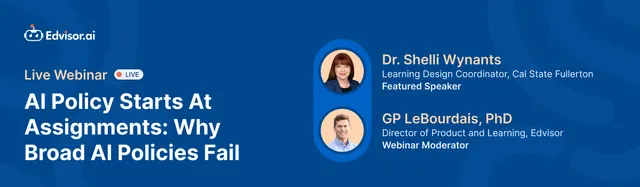
In this conversation, Dr. Shelli Wynants, Learning Design Coordinator at California State University, Fullerton, joins Edvisor's Director of Product and Learning, GP LeBourdais, PhD, to demonstrate how the Transparency in Learning and Teaching (TILT) framework can help faculty make those decisions.
Using real assignment examples, Shelli walks through how to clarify learning goals, scaffold student tasks, and design grading criteria that reveal student thinking. She also demonstrates a free chatbot she developed to help faculty apply the framework to their own assignments.
Key Takeaways From the Conversation
- Start with assignments, not a blanket AI policy. An AI syllabus statement cannot account for every learning objective. Shelli recommends examining individual assignments first to determine where AI should be permitted, restricted, or used in a specific way. Those decisions can then inform the broader course policy.
- Use TILT to make learning expectations transparent. The TILT framework focuses on three elements: purpose, task, and criteria. Shelli adds a question at each stage: Does AI meaningfully support the intended learning, or could it work against it?
- Make students' reasoning part of the assessment. AI can produce a convincing answer without a student understanding the material. Instead of grading only for completeness, faculty can ask students to explain their decisions, evaluate evidence, and identify where they struggled.
- Teach responsible AI use by modeling it. Shelli demonstrates how she uses AI to explore research limitations, identify misconceptions, and test understanding. Students learn to use AI as a learning partner rather than a shortcut to completing assignments.
- Redesigning for AI doesn't mean starting over. Shelli's advice is to begin with one existing assignment. Clarifying its purpose, improving one task, or adding a question that reveals student judgment can be a manageable first step.
“Instead of asking what AI can't do, ask what evidence would show me the student's own judgment.”
- Dr. Shelli Wynants, Learning Design Coordinator, California State University, Fullerton
The Conversation
Edited excerpts for length and clarity. Timestamps refer to the full webinar recording.
GP: Why do you recommend starting with assignments rather than an AI syllabus policy?
Shelli: Most higher education institutions I've interacted with already have sample language or templates for AI syllabus policies. I don't see that as the gap.
My concern is that we ask faculty to start by deciding their course AI policy. That's tough because they're making a general guess without thinking through where AI might help or hurt student learning within their own assignments.
When I work with faculty, I ask them to start with assignment analysis first and the syllabus statement second. Once you've done the thinking at the assignment level, the policy is no longer a guess. (~5:03)
GP: How does the TILT framework help faculty make these decisions?
Shelli: TILT stands for Transparency in Learning and Teaching. It's an assignment-design framework built around three elements.
Purpose explains why the assignment exists and what students will gain from it. Task makes the steps students need to follow visible. Criteria explains how their work will be evaluated.
But TILT existed before generative AI. I think we now need to add another question at each stage: Can AI meaningfully support this learning goal or task, or is it going to work against it?
That's where a single course-wide AI policy often breaks down. You may have AI permitted on some assignments and not others, depending on the learning goal. (~6:41–10:10)
GP: What does that look like when applied to a real assignment?
Shelli: Consider a science assignment where students evaluate the evidence presented in a research poster.
One original question simply asked whether the evidence came from peer-reviewed scientific sources. The revised version asks students to classify individual sources and judge whether the evidence supports the poster's conclusions.
Now students have to demonstrate several steps of their thinking.
But we also have to ask whether AI should perform those steps. If students ask AI to classify every source, they may skip the skill the assignment is supposed to build.
One possibility is to ask students to classify the sources themselves first, then use AI to identify reasoning that may need further examination.
The same tool can produce very different learning outcomes depending on when and how students use it. (~15:10–18:26)
GP: If AI can generate complete answers, how should instructors rethink their grading criteria?
Shelli: I would focus on the evidence of student thinking.
If an assignment is graded only for completeness, AI could potentially generate answers to every question without the student ever examining the source material.
Rather than trying to design a task AI cannot complete, ask what would show the student's own judgment.
For the science poster assignment, I might add a question asking students to identify which source was hardest to classify, explain what made it difficult, and describe how they reached their decision.
It's a small addition, but it asks students to demonstrate the reasoning behind their answer.
I try to focus on criteria that reward evidence of thinking and learning rather than criteria that police AI use. (~20:03–25:41)
GP: How can faculty put all of this into practice without making redesign overwhelming?
Shelli: I built a custom chatbot to help faculty work through the TILT framework.
Faculty can upload an assignment or simply describe it. The chatbot walks them through the purpose, task, criteria, and AI-related decisions one step at a time.
It serves as a brainstorming assistant, and at the end, it can provide a starting draft based on the faculty member's own decisions.
It doesn't require a login, and it won't remember the conversation after the session ends.
But my advice is even simpler: pick one assignment and work through its purpose before you teach it again.
You don't have to redesign your entire course. Start by making the learning purpose clearer to students. (~28:48–32:36)
GP: What does responsible AI use look like when students are learning to read research?
Shelli: I model how I use AI with research articles.
I read the article first. Then I use a prompt that asks AI to identify key ideas, possible misconceptions, research limitations, and terminology that might need clarification.
Finally, I ask it to give me applied questions, one at a time, to test whether I actually understand the article.
If I can't answer those questions well, I know I need to go back and work through the material again.
When students see that process modeled, they begin to understand how AI can help them learn rather than simply complete the assignment for them. (~41:20–44:05)
Audience Q&A: If AI literacy is itself a learning goal, can too much guidance limit students' judgment?
Shelli: There's a balance.
We don't want to prescribe the only correct way to use AI. Students still need room to experiment, make decisions, and discover what works.
In one of my assignments, I include a criterion around the quality of students' iterative interaction with AI.
I'm looking at whether they ask follow-up questions, push back when something is unclear, and explore ideas more deeply.
I'm not giving them a checklist requiring a specific number of questions. I'm making the expectations clear while leaving room for students to exercise their own judgment. (~47:15–49:46)
Resources Shared in the Webinar
Want to apply Shelli's approach to your own assignments? These resources can help you get started.
Try Shelli Wynants' TILT Assignment Chatbot
Use the chatbot demonstrated during the webinar to work through an assignment's purpose, tasks, grading criteria, and decisions about AI use. You can upload an existing assignment or describe one and brainstorm improvements step by step. No login is required, as explained in the webinar.
Explore TILT Higher Ed Resources and Examples
Access the original TILT framework, sample assignments, design checklists, and other teaching resources. The collection includes the Science 101 assignment example Shelli discussed during the webinar, showing how transparent purpose, tasks, and criteria can improve assignment design.
More Resources for AI-Resilient Assessment
Edvisor Assignment Redesigner — Apply a research-backed assessment redesign framework to your own assignments.
AI-Resilient Assessment Guide — Explore practical strategies for designing assessments that support authentic learning in the age of AI.
Dr. Shelli Wynants is the Learning Design Coordinator in the Faculty Development Center at California State University, Fullerton, where she also teaches in Child and Adolescent Studies. Her work focuses on instructional design, faculty development, transparent assignment design, and responsible AI integration in teaching and learning.
Frequently Asked Questions
Why should AI policies start at the assignment level?
Different assignments develop different knowledge and skills. AI may support learning in one assignment while replacing essential thinking in another. Examining assignments individually helps faculty make more informed decisions about when and how students should use AI before developing a broader course policy.
What is the TILT framework?
Transparency in Learning and Teaching (TILT) is an assignment-design framework focused on three elements: purpose, task, and criteria. It helps instructors communicate why an assignment matters, what students need to do, and how their work will be evaluated.
How can faculty apply TILT to generative AI?
Shelli recommends adding an AI-related question to each TILT element. Faculty should consider whether AI supports the assignment's purpose, whether it helps students complete tasks without replacing essential learning, and whether the grading criteria capture evidence of student understanding.
How can instructors assess student thinking when AI can generate complete answers?
Instructors can ask students to explain their reasoning, justify decisions, evaluate sources, or identify difficulties they encountered. These additions help make the learning process more visible rather than relying exclusively on the final submission.
Can AI be used to help students develop research literacy?
Yes, when its use is aligned with the learning objective. In the webinar, Shelli demonstrates how students can read research independently before using AI to explore misconceptions, examine limitations, and answer questions that test their understanding. The goal is to deepen engagement with the research rather than bypass the reading.
Do faculty need to redesign their entire course to become more AI-resilient?
No. Shelli recommends starting with one assignment and examining its learning purpose. Faculty can then make targeted changes to its instructions or evaluation criteria before applying the same approach elsewhere.


