

Webinar Recording: Does Higher Education Really Teach Critical Thinking?
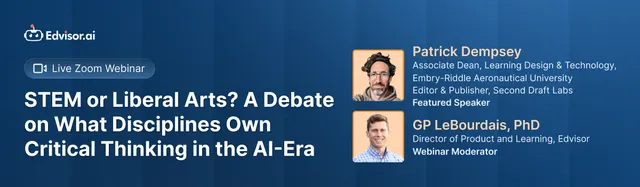
STEM vs. Liberal Arts in the AI Era: A debate on disciplinary expertise, intellectual development, and higher education's promise to students. Patrick Dempsey, EdD, and GP LeBourdais, PhD


This webinar was streamed live on November 17, 2026
Critical thinking is among higher education's most enduring promises. Yet there is remarkably little agreement on what it means, how it develops, or whether universities are preparing students to apply it beyond the classroom.
The evidence raises difficult questions. According to the National Association of Colleges and Employers (NACE), 80.8% of graduating seniors rated themselves highly proficient in critical thinking, compared with just 55.9% of employers who gave recent graduates similarly high ratings.
More recently, AAC&U's 2025 employer survey found that while 66% of employers considered critical thinking very important for entry-level hires, only 40% believed graduates were very well prepared in it.
As generative AI becomes increasingly capable of producing the essays, analyses, and solutions universities have traditionally used to evaluate learning, this discrepancy takes on new significance.
Are we developing independent thinkers, or merely rewarding students for producing convincing evidence of thought? And do the humanities cultivate intellectual capacities that technical disciplines overlook?
In this conversation, Dr. Patrick Dempsey, Associate Dean of Learning Design and Technology at Embry-Riddle Aeronautical University and publisher of Second Draft Labs, joins Edvisor's Director of Product and Learning, Dr. GP LeBourdais, to examine the assumptions underlying how universities define and develop critical thinking.
Their debate moves beyond the familiar STEM-versus-liberal-arts divide to consider a more consequential question: If critical thinking is one of higher education's defining outcomes, how do we know we're delivering on it?
Key Takeaways From the Conversation
- Critical thinking may be higher education's least clearly defined promise. Patrick points to at least 19 competing definitions in academic literature, raising a fundamental problem: how can institutions reliably cultivate or assess a skill they cannot consistently define?
- The liberal arts may not have a monopoly on intellectual development. From aviation to vocational trades, complex professional environments require judgment, adaptability, and problem-solving. The discussion challenges the assumption that academic study necessarily produces more capable thinkers than applied experience.
- Critical thinking may be less transferable than universities assume. Patrick argues that expertise matters. The ability to evaluate an argument in philosophy does not automatically translate into solving an unfamiliar engineering or business problem.
- The gap between educational promises and workplace expectations deserves scrutiny. NACE's research suggests a substantial difference between graduates' confidence in their critical thinking abilities and employers' assessments of those same capabilities. What might this discrepancy reveal about how universities measure learning?
- Perhaps the problem is how we teach, rather than what we teach. Both speakers explore whether conventional course structures, abstract instruction, and disciplinary boundaries provide sufficient opportunities to develop judgment. Their discussion points toward contextualized ethics, interdisciplinary learning, and more authentic problem-solving.
"More and more, I believe what AI is showing us and what employers are looking for are people who actually can make a problem intelligible and solvable. And that probably takes critical thinking, but it also takes domain subject matter expertise to some degree."
— Patrick Dempsey, Associate Dean of Learning Design and Technology, Embry-Riddle Aeronautical University
The Conversation
Selected exchanges from the webinar, lightly edited and condensed for clarity.
Can We Teach Critical Thinking Without Agreeing on What It Means?
GP: If we can't even agree between different schools, or between industry and higher education, on the specific skills that constitute critical thinking, it becomes difficult to know whether we're delivering on that promise for students.
Patrick: In the literature, I found no fewer than 19 competing definitions. I think it's useful to have a working definition, but I'm still not sure it's the definition.
Patrick revisits John Dewey's conception of reflective thought as a suspension of judgment, questioning whether contemporary definitions have made the concept unnecessarily complicated.
Why Would an English Major Think More Critically Than an HVAC Technician?
GP: Why is it that we think English majors have some sort of superior claim to critical thinking than an HVAC technician?
Patrick: Someone working in the trades encounters unfamiliar challenges, diagnoses problems, deals with customers, and makes decisions within specific constraints. Those are precisely the kinds of activities we associate with critical thinking.
Their exchange raises an uncomfortable possibility: that some distinctions between academic and vocational intelligence reflect cultural assumptions about educational prestige rather than demonstrated differences in reasoning ability.
Critical Thinking and Problem Solving: Does Disciplinary Expertise Matter?
Patrick: I'm certainly better at thinking critically about things that I know about. Employers want critical thinking in the context of the constraints they're facing, less so as a general skill.
GP: Critical thinking arises, to a significant extent, from expertise in the area where someone is being asked to think critically. But what counts as disciplinary expertise, and how broadly should we define it?
The discussion considers whether universities should focus on transferable habits of mind or help students develop the depth of knowledge necessary to reason effectively within particular contexts.
Teaching Critical Thinking: Is Higher Education's Model Part of the Problem?
Patrick: Even if particular content develops critical thinking, I'm skeptical that the cadence we've established is necessarily the right way to develop it.
GP: Certain disciplines encourage students to slow down, question the assumptions underlying information, and consider ethical implications. Those habits may be especially valuable when technological systems reward speed and efficiency.
Here, the conversation shifts from disciplinary content to pedagogy itself. Are students becoming more capable thinkers through the educational experiences we provide, or are universities relying on assumptions about the intellectual benefits of conventional coursework?
What Might Interdisciplinary Education Look Like in the AI Era?
GP: Could we embed the liberal arts throughout a student's education, rather than treating them as requirements completed at the beginning of a degree?
Patrick: Consider ethics in aviation. You're not necessarily learning something different from ethics in dentistry or an introductory ethics course. You're taking abstract ideas and making them particular to a field.
Both speakers consider the value of learning experiences that connect ethical reflection, disciplinary knowledge, and real-world application rather than treating them as separate educational goals.
The broader implication is that the question may not be whether STEM or the liberal arts better cultivates critical thinking, but whether either approach is sufficient in isolation.
Further Reading and Resources
- Assessment Design for the AI Era: An Educator's Guide - Explore approaches to assessing student reasoning and designing learning experiences that remain meaningful when AI can generate polished answers.
- What Education Becomes - A Second Draft Labs publication examining teaching and learning in a world where AI is an established part of education.
- Transparency and Reflection - A Second Draft Labs publication exploring how educators can make student thinking more visible in AI-enabled learning environments.
Frequently Asked Questions
Does critical thinking belong to STEM or the liberal arts?
Neither discipline has an exclusive claim to critical thinking, although research suggests that students' performance on critical thinking assessments varies across fields.
In a 2012 study involving 12,632 graduating seniors across 236 institutions, Steedle and Bradley examined performance on the Collegiate Learning Assessment (CLA). After adjusting for students' incoming academic ability and other characteristics, natural sciences students performed 14.6 points above expectations, followed by social sciences (+11.0) and humanities and languages (+4.8). Technology, engineering, and mathematics students scored 7 points below expectations, while business students scored 13.2 points below.
These results do not establish that one discipline inherently produces better thinkers. They suggest that the intellectual demands and learning experiences associated with different programs deserve closer examination.
Are universities adequately preparing students to think critically?
Employer surveys consistently suggest a gap between the importance placed on critical thinking and graduates' perceived proficiency.
NACE's Job Outlook 2026 Spring Update found that 93.5% of responding employers considered critical thinking very or extremely important, but only 50% rated recent graduates as very or extremely proficient.
Similarly, AAC&U's The Agility Imperative (2025), based on a survey of 1,030 executives and hiring managers, identified a 26-percentage-point gap between employers who considered critical thinking very important and those who believed graduates were very well prepared in it.
These findings raise questions about whether universities are defining, teaching, and assessing critical thinking in ways that correspond to the demands graduates encounter after college.
Can critical thinking be taught as a general skill?
The extent to which critical thinking transfers between disciplines remains a significant question in educational research.
Students may demonstrate sophisticated reasoning within a familiar subject yet struggle to apply similar judgment in unfamiliar contexts. Knowledge of the domain, its evidence, and its constraints can influence how effectively someone evaluates a problem.
This distinction is central to Patrick and GP's debate. Rather than assuming that general exposure to intellectually demanding coursework produces universally transferable reasoning abilities, educators may need to consider how critical thinking is practiced within and across disciplinary contexts.
How Can Faculty Develop Critical Thinking Skills in the Classroom?
Evidence suggests that the intellectual demands of coursework matter.
In Academically Adrift: Limited Learning on College Campuses (2011), Richard Arum and Josipa Roksa found that students who took courses requiring more than 40 pages of reading per week and more than 20 pages of writing per semester demonstrated greater gains in critical thinking, complex reasoning, and writing skills.
The findings suggest that sustained engagement with complex material and opportunities to formulate written arguments are associated with stronger learning outcomes. They do not establish that a particular amount of reading or writing, by itself, causes those gains.
The implications extend beyond humanities programs. Business, engineering, and other professionally oriented disciplines can also design coursework that asks students to interpret evidence, defend judgments, and grapple with uncertainty.
Can humanities-based learning improve critical thinking in technical fields?
Some research suggests that learning experiences traditionally associated with the humanities can strengthen specific abilities used in other disciplines.
In a 2001 study published in JAMA, Dolev, Friedlaender, and Braverman examined whether studying and discussing fine art could improve medical students' observational skills. The 81 students receiving visual training improved their observational performance by approximately 10%, compared with a control group of 65 students.
A separate 2014 study by Greene, Kisida, and Bowen found that school students randomly assigned to visit an art museum demonstrated improvements in critical thinking about unfamiliar artwork. The benefits were particularly pronounced among students from disadvantaged backgrounds.
While these studies examine different populations and outcomes, they illustrate how carefully designed experiences involving observation, interpretation, and reflection may develop abilities that extend beyond their original learning contexts.
Why might slower, more reflective learning matter in the age of AI?
When answers, explanations, and analyses can be generated almost instantly, the ability to examine information critically becomes particularly consequential.
In The Power of Patience (2013), Harvard art historian Jennifer L. Roberts describes asking students to spend three hours examining a single painting before conducting additional research. The exercise encourages students to recognize details, relationships, and questions that are often missed during initial observation.
Although this is a teaching example rather than a controlled study, it illustrates an important pedagogical distinction: having immediate access to information is not equivalent to developing understanding.
For faculty teaching in AI-enabled classrooms, the challenge may be to preserve opportunities for students to question assumptions, examine evidence, and develop independent judgments rather than simply arrive at plausible answers.
How Is AI Changing Critical Thinking Assessment in Higher Education?
Generative AI can produce written arguments, summaries, and solutions that resemble traditional demonstrations of academic achievement. This complicates the relationship between a student's submitted work and the reasoning processes that produced it.
The question is no longer simply whether students can complete an assignment, but whether the assignment provides meaningful evidence of their understanding.
Educators may need to place greater emphasis on students' ability to explain decisions, evaluate competing interpretations, defend conclusions, and apply knowledge to unfamiliar problems.
Approaches such as oral examinations, reflective assessments, authentic problem-solving tasks, and structured questioning can help make students' reasoning more visible, particularly when AI is involved in completing academic work.
Why Is Critical Thinking Important for Students in the Age of AI?
As generative AI becomes increasingly capable of producing essays, analyses, and solutions, students need to do more than demonstrate that they can arrive at an answer. They must be able to evaluate evidence, identify flawed assumptions, and exercise independent judgment.
They need to move beyond rote memorization and learn to analyze information objectively, evaluate evidence, and solve complex problems.
What Does Research Reveal About Critical Thinking in Business Education?
Research suggests that professional relevance alone does not guarantee stronger critical thinking outcomes.
In Steedle and Bradley's 2012 analysis of Collegiate Learning Assessment scores, business graduates performed 13.2 points below expectations after adjusting for incoming academic ability, ranking last among seven disciplinary categories.
These findings do not establish that business education weakens critical thinking. In fact, business education teaches critical thinking to adapt to changing markets and algorithms to avoid costly errors. They raise questions about how business programs structure opportunities for students to analyze complex information, evaluate competing explanations, and defend decisions.
The implication is particularly relevant to AI-enabled professional education, where students increasingly need to distinguish between generating solutions and exercising informed judgment.


