

Webinar Recording: What Does an AI-Resilient Assignment Actually Look Like?
Susan Ray redesigned her classroom assignments for the AI era without banning AI or chasing detection tools. Watch how and what changed for her students.


Most college assignments are designed so that instructors can review a finished product: an essay, a lab report, a case memo. In the past, those products were also the evidence of student effort, reflecting their thought process, understanding, and effort. The advent of generative AI has severed the product from its evidentiary power, requiring new ways of assessing student work.
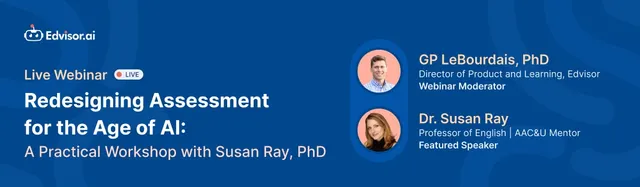
In this conversation, Susan Ray, PhD, associate professor of English at Delaware County Community College and a national consultant to AAC&U on AI instruction, joins Edvisor's Director of Product and Learning, Dr. GP LeBourdais, to walk through how she rebuilt her own assignments around that problem, live, using real submissions from the audience. Her process entails a set of small, specific redesigns that make a student's thinking visible and teach them how to use different AI tools critically as they prepare for the job market.
Redesigning Assessment for the Age of AI: A Practical Workshop with Susan Ray, PhD
Key Takeaways From the Conversation
- Breaking the detection-surveillance cycle. Ray's assessments don't try to catch AI use after the fact. They change what the assignment asks for, so a student can't move through it without doing the thinking the assignment was meant to teach.
- Small friction beats a big ban. A short, unscripted follow-up conversation about one paragraph of a student's own writing does more than any policy. Students who can't explain their own work the first time can, reliably, the second time, once they know the check is coming.
- Personalize the practice, not just the policy. Instead of teaching grammar to a whole class at wildly different levels, Ray has each student bring the one issue she flagged for them, and lets AI build a quiz around it, on a topic the student picks.
- AI can be the sparring partner, not the ghostwriter. Ray's students use AI to generate the strongest counterargument against their own thesis, then respond to it, log the exchange, and reflect on it. The tool argues back. It doesn't write the essay.
- It has to be manageable, or it doesn't survive contact with a real course load. Ray's advice: pick one assignment, add one point of friction, and tie it to an outcome the course already claims to teach, so the redesign strengthens something you're already responsible for.
“I found ways to bring AI into the process where they preserve their voice. They don't let it write for them. They don't let it think for them. It's just a tool, like a calculator would be in a math class.”
— Susan Ray, PhD, Associate Professor of English, Delaware County Community College
The Conversation
Lightly edited for length and clarity. Timestamps refer to the full recording.
GP: You've been teaching composition for two decades. What was it like when AI first showed up in your classroom?
Susan: My background is humanities, a doctorate in Victorian literature, about as non-AI as you can get, but my father was a computer science professor, so I grew up watching technology evolve in the background. About two years ago I started getting this influx of writing that just wasn't my students' writing. Very dry, graduate-level prose about complex topics from students who hadn't written that way before. As a community college instructor, my students are very invested in improving their career opportunities, and there was a Microsoft-LinkedIn study a couple of years back that found two-thirds of employers, across nursing, teaching, manufacturing, wanted graduates to arrive with AI skills. So that's when I started looking for ways to bring AI into the process where they preserve their own voice. They don't let it write for them. They don't let it think for them. It's just a tool, like a calculator would be in a math class. (~3:47)
GP: Walk us through the grammar exercise you mentioned. That seemed like a small thing with a real effect.
Susan: When you're teaching a diverse classroom, especially at a community college, you have students writing at a graduate level next to second-language learners, in the same room. So instead of doing a whole-class lesson on, say, sentence fragments, I gave students feedback and had them choose the one writing issue I'd flagged for them. Then I gave them a prompt where AI would build a quiz around that specific issue, on whatever topic they picked, K-pop demon hunters, the Philadelphia Eagles, whatever. They'd answer the questions, then evaluate how well it actually helped them practice that skill. It worked because it was theirs. (~20:13)
GP: You built some tools around this idea of adding friction. What does that actually look like day to day?
Susan: I built two chatbots. One brings AI into the process: a student creates something like the grammar quiz, shares that process with me, and reflects on it. The other has no AI at all, for anyone who decides that's the right call for a given assignment, which is sometimes the correct choice. Both are free to log into, through ChatGPT or Boodlebox. I also run something in class called the AI Transparency Journal. Every time a student engages with AI, they date it, paste the whole transcript, and give me a couple of sentences on how they think it went. If I've set up a chatbot to generate a counterargument against their thesis, they have that conversation, post it to the journal, and reflect on it. It's not meant to write anything for them. It gives suggestions and walks them through the thinking. (~21:46, ~25:18)
GP: You also redesigned a biology lab report live on the call, even though biology isn't your field. What did that process actually look like?
Susan: Honestly, I haven't taken biology in years, so all I had was the assignment text itself as an anchor: explain how a change in temperature affects [X]. Redesigning it live broke into three distinct approaches to keep student thinking visible: a one-page causal diagram, written by hand; a short data-point defense where they explain a specific number; and a "mechanism challenge" they work through with others. I don't understand the biology. It's just a brainstorming partner for stretching the assignment out enough that you can actually witness someone's thinking, instead of just grading whether the final report reads correctly. (~27:19)
GP: Tell me about the follow-up conversations you started having with students after they turn in written work.
Susan: Once a student submits something written, I have them get on camera and answer a new, unscripted question about it, on the spot. The first time, there's a real deer-in-headlights look. It can eat the entire response. The next time, they're far more prepared, because they know the follow-up is coming: describe why you chose this source over that one, or what would change about your argument if we altered the premise it rests on. It's practicing the spoken rhetorical skills they'll need in whatever field they end up in, and it's practicing transfer, taking something you've learned and applying it somewhere new. Faculty tell me they don't have time to interview fifty students, but you don't need a full interview. Short, formative feedback on how someone responds to something written can carry through the rest of the class. (~38:11–39:42)
GP: Faculty always ask this: Claude or ChatGPT?
Susan: I think Claude for Education will be great for higher ed eventually, but right now it's mostly focused on K-12. In my own use, if I'm having a pedagogical debate, sitting in the hammock with my earbuds in, asking something to challenge me on an assignment, Claude is the stronger mainstream model for that kind of philosophical, academic discussion. When I need something technical broken down, ChatGPT is my best friend. I'll literally ask it to explain something like I'm twelve, which my actual twelve-year-old finds very offensive. (~42:14)
GP: This all sounds valuable, but also like a lot more grading. How do you keep it manageable?
Susan: I tell students up front: this is an all-or-nothing assignment. I'm not grading grammar or spelling here. I'm looking for whether you gave it a real try and showed me your thinking, and if you did, it's full credit. You have to make those calls, because it has to be manageable. Nobody wants to be grading from morning until dusk. Every faculty member has to figure out that trade for themselves. (~44:47)
Ray closed by pointing to a bigger structural fix: connect these redesigns to program-level learning outcomes, not just course-level ones, so a redesigned assignment strengthens something the program already claims to teach instead of becoming one more isolated task stacked on a full course load. (~45:20)
Try it Yourself
Assignment Redesigner — walks through the same kind of redesign Ray did live, applied to your own syllabus.
AI-Resilient Assessment Guide
Susan Ray's AI-friction chatbot (with AI)
Susan Ray's friction chatbot (no AI)
What Education Becomes — Ray's co-authored book with Patrick Dempsey / Second Draft Labs
Susan Ray, PhD, is an Associate Professor of English at Delaware County Community College and a faculty consultant for AAC&U’s Institute on AI, Pedagogy, and the Curriculum. Her work focuses on ethical AI integration and redesigning learning experiences so students use AI without giving up their own thinking and voice.
Frequently Asked Questions
What does "redesigning an assignment for AI" actually mean?
It means changing what an assignment asks a student to produce, so that finishing it requires the thinking the course is meant to teach, not just a polished final product. Ray's redesigns add process checks, oral follow-ups, or personalized practice rather than relying on a longer detection policy.
Is banning AI in the classroom still a workable policy?
Ray doesn't ban AI outright. She treats it as a tool students should learn to use deliberately, the way they'd use a calculator, while keeping specific moments, like a first draft of an argument or a diagram, free of it when the point of the exercise is the struggle itself.
How can professors add process checks without doubling their grading load?
Ray keeps these short and selective: a few minutes of live follow-up on one flagged issue per student, not a full re-grade of the whole assignment. She also uses all-or-nothing credit on some low-stakes work, grading for evidence of real thinking rather than polish, to keep the workload sustainable.
Should professors use AI to help design their own assignments?
Ray does, and argues that faculty owe students the same transparency they ask of them: if AI helped generate an assignment, an example, or feedback, students should know that.
What should students learn in an AI-supported classroom?
According to Ray, students still need to be able to explain and defend their own thinking, not just produce a correct-looking answer. The follow-up conversations and AI Transparency Journal are both built to keep that skill visible and practiced, even as AI handles more of the first draft.


