
Oral Exam Benefits: What AI Can't Do for Your Students
Oral exams can help professors quickly check student student understanding and build their communication skills.


Written assignments are good, but they cannot capture the entire spectrum of a student's understanding. What's more useful than a written answer? A real-time conversation between an instructor and a student. Professors get an opportunity to hear the students explain their reasoning. The back-and-forth can really test the student's ability to communicate as well as their critical thinking.
One may think this is only useful as an examination method, but it has applications beyond that. Generative AI is giving oral exams a second life. A chatbot can write the essay. It can't sit across from you and explain why it made that argument, and a couple of follow-up questions show quickly whether the student can. The AI industry keeps evolving and creating better outputs, and it will keep increasing students' dependence on it. Oral exams can really test students through follow-up questions that require them to use their own minds to answer.
What Are Oral Exams (Viva Voce)?
Oral exams are the conversational alternative to written exams. Instructors assess students’ understanding of course concepts by allowing them to explain their thinking in real time in an interactive viva voce format. Oral exams and presentations are different because oral exams are interactive. The student can’t deliver prepared answers, and instead they have to respond to evaluative questions.
Oral exams are older than written ones. Written exams took over in the late 1800s, when classes got too big to question every student, and generative AI is bringing oral exams back. Their interactive nature offers instructors a valuable opportunity to assess independent thinking.
Why Oral Exams? Understanding the Benefits of Oral Exams Today
An oral exam answers the question a written submission no longer can: does this student understand the material, or did something else write this? Maintaining academic integrity is important for professors. How can they inculcate good leadership skills in students when they lose their power of thinking to AI? As higher education adapts to the use of generative AI, the benefits of oral tests have emerged as a renewed interest for professors. Complex reasoning is hard to fake in a conversation, especially when asking students to apply learned concepts to real-world contexts. Oral exams are especially useful when combined with other assessment methods. Let’s look at how oral exams can prove to be efficient, authentic assessments and how they build the communication skills students need after graduation.
Try Our Free Research-Backed Assessment Redesigner
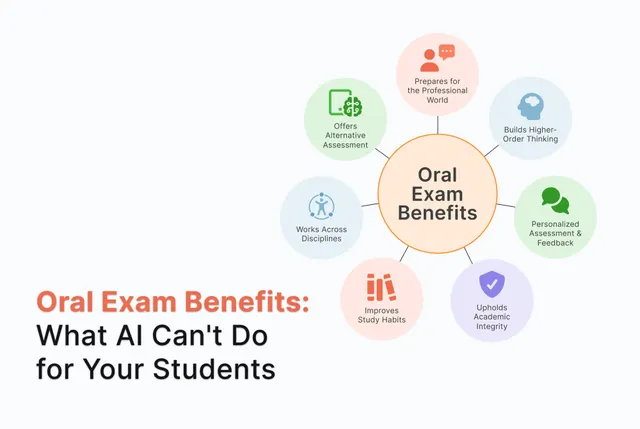
Prepares Students for the Professional World
Academic knowledge is not enough to create good leaders. A lot of tough work scenarios require students to exercise practical decision-making and communication skills. Within months of graduating, your students will sit behavioral interviews where they have to explain a decision on the spot. If every assessment they've had was written, that interview is the first time they've practiced it. Students need to know how to use their knowledge and experience and organize their thoughts in the moment. Regular oral tests can create opportunities for them to communicate clearly with good supporting examples.
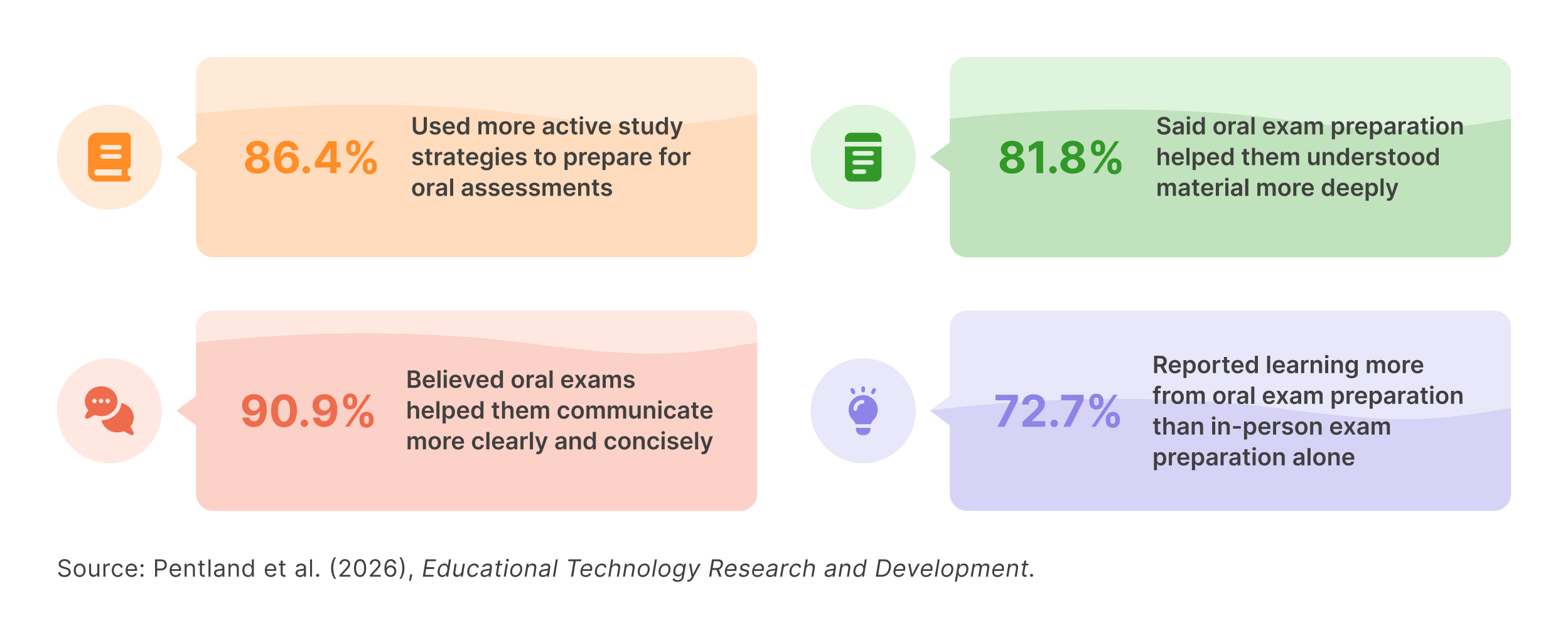
In a 2026 study, Pentland et al. found that 90.91% of surveyed students (n = 22) perceived asynchronous oral assessments as more closely aligned with workplace communication skills than traditional exams.
Measures Higher-Order Thinking
As discussed above, leadership demands a lot of spontaneous but informed decision-making. How can students get a chance to develop these skills when all they do is simple recall? And if AI assists them with the more challenging tasks, then their higher-order thinking never builds. During work, decision-making scenarios require professionals to weigh options, learn from mistakes, and evaluate past experiences. Ticking answers and not being able to justify the choice does not develop the rigor required for this. These skills are particularly important in professions where communication directly affects decisions and outcomes. For example, Frate and Rote (2026) emphasize the value of oral exams in health sciences education, where future professionals must communicate complex information clearly and respond effectively in real time.
Makes Student Reasoning Visible
When they do this, they can express a deeper understanding of concepts in their subject matter. In a 2026 study, Lindkvist et al. found that requiring students to defend their written work through an oral examination encouraged them to take greater responsibility for their own understanding. Knowing they would need to explain and justify their answers reduced the perceived value of relying on AI-generated content. Similarly, Al Saadi et al. (2026) found that requiring students to explain and defend their work through live questioning made their reasoning more visible and helped expose gaps in conceptual understanding. Across 23 student groups, the researchers identified evidence of verbal explanation and accountability, showing how interactive assessment can move beyond evaluating the finished work to examining students' ability to justify it.
Explore practical ways to make assessments AI-resilient
That gives you a fuller picture of what a student knows than a written answer alone. Students can also ask questions for clarification, and instructors can offer supportive prompts to help them through the problems. This makes oral exams useful not only for assessing what students know but also for understanding how they approach problems (Sayre, 2014; Iannone & Simpson, 2015).
Fields such as healthcare, education, defense, and management require students to demonstrate these skills regularly.
Upholds Academic Integrity
During an oral exam, students can’t rely on answers they rote-learned or copied during the course. They have to explain concepts in their own words, and this can help professors address academic integrity concerns. Since most professors have to play detective and figure out which student is actually learning and which isn’t, oral exams are a good remedy for AI detection. If any discrepancies in oral exams and take-home assessments are found, professors can take the necessary actions. This can include changing course and assessment design to improve for anti-cheating measures.
Ogle and Jarrett (2026) reported no identified academic integrity breaches after introducing structured oral assessments for a cohort of roughly 700 nursing students. The assessments combined real-time responses with identity verification, supervised preparation, and multiple case variants. It demonstrates how oral assessment design can support academic integrity.
Changes Student Study Habits
Even before the oral exam begins, it can influence students’ learning process. When they know that they will need to explain anything on the spot, they read material thoroughly. Iannone et al. (2020) found that students were more likely to use deeper understanding revision strategies for oral exams rather than written ones. This was also more recently observed in large university courses. In a 2026 report by The Chronicle of Higher Education, engineering professor Huihui Qi reported something similar. They described that students began changing their study habits after oral exams were introduced. Some practiced explaining homework problems aloud, while others rehearsed questions with classmates. Surveys from this study found:
- Approximately 70% of students reported increased motivation to learn
- 72% reported improved understanding
- About one-third independently changed their study strategies.
Works Across Disciplines
A worked solution shows which equation a student used. Only a conversation shows whether they know why. Multiple recent studies have compared the efficacy of oral exams across different disciplines. These include mathematics, religious studies, business, physics, medicine, and modern languages (Hazen, 2020; Nyamadzawo, 2025). A systematic review of 24 studies by Stephenson et al. (2025) also shows their application across different areas of higher education. An essay can not be used to justify why a student used a certain equation to solve a problem. With access to AI, that justification can even easily be produced. But live reasoning offers flexibility to instructors, and they can create questions to reflect the learning outcomes of their subject area.
Means of Alternative Assessment
Designing oral assessments is extra work, yes. However, it greatly benefits the students who need an alternate means of expression. For students whose writing doesn't reflect what they know, including some multilingual learners, an oral option gives them another way to show it. Nyamadzawo (2025) reported higher pass rates in oral assessments when first-year students in South Africa were tested using written and oral assessments both. As students get more opportunities to explain their work, those who are not good at written work can get a chance to share their understanding. This also aligns with Universal Design for Learning (UDL), one of Edvisor's core focuses.
What Professors Think About Oral Examination Methods
Jason Linn, a history lecturer at Cal Poly San Luis Obispo, got tired of grading take-home essays he suspected were AI-written. So last finals season he swapped them for oral exams: 71 of them, over 12 days, across two lower-division history courses. Most ran about 20 minutes. Afterward, he said a calendar of eight appointments felt less daunting than a stack of exam booklets, though no-shows and the mental stamina it took were real costs. His experience lines up with what other faculty report:
- Stronger student relationships: Gen Z and especially post-COVID students have lost their focus and ability to communicate properly. Professors need a better way to build rapport and understand their individual needs. Oral exams offer the perfect method for one-on-one interaction. Some faculty find oral exams more personally rewarding because they lead to meaningful academic conversations with students.
- Student anxiety: Many students get anxious when they don’t know the format of the exam. This can be solved by providing a low-stakes practice round and setting clear expectations. A supportive questioning format also helps students prepare and practice speaking.
- Fairness and consistency: Grading can seem vague and biased to students and difficult for professors during oral exams. Professors should have rubrics ready for consistency, and in some cases, they should be trained as well.
- Time commitment: Oral exams require scheduling and preparation, but immediate grading can save a lot of time. Jason Linn gave 71 of them in 12 days, most around 20 minutes each. At UC San Diego, Huihui Qi’s team kept engineering oral exams to about 15 minutes, but found they only worked with roughly one TA or instructor for every 24 students. Some faculty say the total time evens out against designing and grading written tests, since grading happens during the conversation. For a 150-student course without TA support, though, the math is hard.
- Scalability: If one-on-one exams don’t seem doable, faculty can also group assessments and use hybrid written-oral formats. Faculty emphasize that oral exams are most effective when used alongside other assessment methods rather than as a universal replacement for written tests.
Some Cons of Oral Exams
Here are some of the limitations that should be kept in mind for thoughtful planning:
- Potential grading bias: Bias in grading can occur if the professor is influenced by student communication style or other perceptions.
- Limited question coverage: Professors can’t cover all the questions they want to when there is a time constraint. Although this can be solved by focusing on important course content, it could lead to substantial material being missed.
- Accessibility considerations: Oral exams may become even more challenging for students with speech difficulties or anxiety. Instructors can apply appropriate accommodations so that those students can show learning outcomes.
Implementing Oral Exams
Working out the logistics of oral exams is overwhelming. Most professors want to fight the use of AI in their class by adding it in some way into the course but don’t know how to ensure efficiency. Here’s a step-by-step approach to get started:
Step 1: Decide what you want students to demonstrate
Professors should decide which learning outcomes of the course to assess in a conversation. They can do that by selecting a small number of concepts. Focus on concepts that can be tested through application and decision-making questions.
Step 2: Choose a format that works for your class
Individual exams are good if there is enough time to question each student. Otherwise, small-group discussions should be the mode of operation.
Step 3: Create questions that encourage explanation
Sometimes professors start following an MCQ format during oral exams. This doesn’t help because they encourage students to memorize. Practical scenarios and open-ended questions show student understanding, so design questions accordingly.
Step 4: Set grading, format, and inform students in time
Professors should do their homework by creating a structure and allowing students to prepare too. Only then can the exams reap the benefits required from the course.
Step 5: Plan the logistics
Reserve a quiet location or arrange online sessions. Then build a schedule that accounts for transitions and unexpected delays. Accommodations for students should be made before the exam too.
Step 6: Grade responses and provide timely feedback
Stephenson et al. (2025) identified timely, constructive feedback as an important contributor to students' oral assessment performance.
Step 7: Ask students to reflect and improve the next exam
The assessment shouldn't end with a grade. Students should reflect on their mistakes, and professors should review their teaching methods if a concept is generally misunderstood.
How Does Edvisor’s Oral Defense Feature Assess Students?
Keeping in mind all the considerations and cons of oral exams, the Edvisor Team has created a feature to make it easier for professors to implement oral exams. The hardest part of oral exams is time. Questioning 80 students one by one takes days. Oral Defense adds a short spoken follow-up to the assignments you already give, so you get evidence of understanding without scheduling a single meeting. Using the fight AI with AI approach, we built an oral exam layer into the assessments module.
How it works
When students submit an answer, a prompt pops up on their screen to ask them to elaborate on their submission. How do they submit this reasoning? With an audio recording. The professor can time this submission response or allow unlimited time. The AI also asks follow-up questions so that they can show real understanding.
Students are evaluated against instructor-defined criteria and rubrics. Professors can later review the recorded responses to get additional insights into student learning. This way, oral assessments can complement written exams.
The feature can assess several aspects of student learning, including:
- Conceptual knowledge
- Applied knowledge
- Critical thinking
- Depth of comprehension
- Ownership of submitted work
If you’re ready to implement oral exams without going through the entire course design process again, discover how Edvisor can help you get started in less than 72 hours.
References
Pentland, S. J., Lowenthal, P. R., & Krier, K. (2026). Asynchronous oral assessments: Enhancing integrity, engagement, and communication in the AI era. Educational Technology Research and Development. https://doi.org/10.1007/s11423-026-10677-0
Frate, S. D., & Rote, A. E. (2026). Oral examinations as an alternative to written exams in health sciences education: A targeted response to AI challenges. Pedagogy in Health Promotion, 12(3), 203–208. https://doi.org/10.1177/23733799261416471
Al Saadi, K. K., Hussain, R. M., & Hwang, G.-J. (2026). AI-supported doodling and gallery walk defence provide visible evidence of student reasoning in higher education assessment. Discover Artificial Intelligence, 6(1), Article 1195. https://doi.org/10.1007/s44163-026-02234-8
Sayre, E. C. (2014). Oral exams as a tool for teaching and assessment. Teaching Science, 60(2), 29–33. https://doi.org/10.3316/aeipt.203840
Iannone, P., & Simpson, A. (2015). Students’ views of oral performance assessment in mathematics: Straddling the ‘assessment of’ and ‘assessment for’ learning divide. Assessment & Evaluation in Higher Education, 40(7), 971–987. https://doi.org/10.1080/02602938.2014.961124
Lindkvist, A., Curbo, S., & Hultgren, C. (2026). Choosing not to use generative AI in higher education: A mixed methods study of student reasoning, assessment design, and AI literacy. Frontiers in Education, 11, Article 1813306. https://doi.org/10.3389/feduc.2026.1813306
Ogle, T., & Jarrett, P. (2026). Replacing written assessment with an oral ISBAR assessment in a 700-student cohort: Cohort-level outcomes for performance, integrity, and staff experience. Assessment & Evaluation in Higher Education, 1–17. https://doi.org/10.1080/02602938.2026.2684284
Iannone, P., Czichowsky, C., & Ruf, J. (2020). The impact of high stakes oral performance assessment on students’ approaches to learning: A case study. Educational Studies in Mathematics, 103(3), 313–337. https://doi.org/10.1007/s10649-020-09937-4
Hazen, H. (2020). Use of oral examinations to assess student learning in the social sciences. Journal of Geography in Higher Education, 44(4), 592–607. https://doi.org/10.1080/03098265.2020.1773418
Zhao, Y. (2018, March). Impact of oral exams on a thermodynamics course performance [Conference paper]. 2018 ASEE Zone IV Conference, Boulder, CO, United States. https://doi.org/10.18260/1-2--29617
McMurtrie, B. (2026, September 2). The return of the oral exam. The Chronicle of Higher Education. https://www.chronicle.com/article/the-return-of-the-oral-exam
Nyamadzawo, R. T. (2025). Oral versus written assessments: A reflective study on promoting equality in evaluations in higher education. Educational Research for Social Change, 14(2). https://doi.org/10.17159/2221-4070/v14n2a2
Stephenson, Z., Johnson-Glauch, N., & Cruchley, S. (2025). Interventions and facilitators of oral assessment performance in higher education: A systematic review. Assessment & Evaluation in Higher Education, 50(7), 1140–1153. https://doi.org/10.1080/02602938.2025.2504621
Linn, J. (2026, April 20). What I learned from giving 71 oral exams in 12 days. Faculty Focus. https://www.facultyfocus.com/articles/educational-assessment/what-i-learned-from-giving-71-oral-exams-in-12-days/
Hartmann, C. (2025). Oral assessments for a generative AI world: Managing concerns and logistics for undergraduate humanities instruction. College Teaching, 1–10. https://doi.org/10.1080/87567555.2025.2558563
Gardner, D. E., & Giordano, A. N. (2023). The challenges and value of undergraduate oral assessments in the physical chemistry classroom: A useful tool in the assessment toolbox. Journal of Chemical Education, 100(5), 1705–1709. https://doi.org/10.1021/acs.jchemed.3c00011
Frequently Asked Questions
What are the key benefits of viva voce and oral exams?
Oral exams show whether students understand the material well enough to explain it in their own words. That makes them harder to complete with AI, and they build the communication skills written tests don't.
Can an examiner use AI for oral exam assessments?
Higher ed institutions are turning to oral exams (also known as viva voce) to address AI cheating. Students can solve problems and create essays easily with AI, so instructors make sure the submitted work is theirs by testing their knowledge through a conversation. es. AI oral assessment tools can ask students follow-up questions about their submitted work, record the answers, and score them against your rubric, with the instructor reviewing the results.


