

Knowledge Check: Definition, Examples & Best Practices
Knowledge check acts as a formative assessment tool. Test student understanding with short, low-stakes knowledge check questions.


A professor assigns the chapter. Quiz scores look fine. Then they ask one follow-up question in class and get silence.
It's a familiar gap. Students do the reading, turn in the quiz on time, and still can't explain the idea they were supposedly tested on. Usually nobody notices until the midterm or the final project, and by then there isn't much time left to do anything about it.
AI makes it worse. A student can drop the reading into a chatbot, skim what comes back, and still get the quiz right. The answer is correct. Whether the student actually thought about any of it is anyone's guess.
That's where knowledge checks can help, and there's research behind the approach. A 2025 study of 703 university and community college students found that inserting brief quizzes into online lectures improved learning and next-day recall compared with simply reviewing the material. Instructors already do some version of them: three questions after a reading, a prompt at the start of class. Built in on purpose, they show a professor who's lost early enough to help. And they don't have to pile on grading. This blog post walks through what a knowledge check is, how it differs from a regular quiz, and how professors run them without losing their weekends.
What Is a Knowledge Check?
A knowledge check is a short, informal assessment. It is typically placed in the middle or immediately after a reading or learning module. Students answer them to see if the material was actually understood. There's no grade attached and nothing at stake, which is the main purpose of the knowledge check. Students can find out they have not comprehended chapter four before chapter five starts. As the learning gaps are revealed, they can be corrected immediately by going back into the reading material.
If you are wondering what is a knowledge check, it is simply a low-stakes opportunity for students to check knowledge and review concepts before moving forward.
It is a form of formative assessment to improve student performance. The idea is to make students recall information, apply a concept, or reflect on what they learned. They don't always have to be a multiple-choice question; it could be any learning activity that encourages curiosity and provides feedback on it. This kind of active learning helps students and instructors see whether they are ready to progress or not.
They can be administered through classroom discussions, LMS, interactive readings, or oral assessment activities.
Many instructors use check your knowledge quizzes or an interactive knowledge check quiz so learners can easily review knowledge check answers and self-correct.
Knowledge Check vs Quiz vs Exam
These terms are used interchangeably, but the instructional purpose is different for each. Knowledge check is not graded so that the learner can be intellectually honest. Retakes are also permissible to allow students to revisit the unclear part. Here’s a summary of their differences.
A quiz can also function as a knowledge check when its purpose is formative, so professors should make a distinction between these terms according to the purpose- does it measure achievement or improve student understanding?
Why Are Knowledge Checks Important?
A right-or-wrong score is the least interesting thing a knowledge check produces. What matters is that students have to dig up what they learned and do something with it.
1. They make students recall instead of reread
Rereading feels productive. When students go through a chapter three times, and the material starts to look familiar, it's easy to confuse that familiarity with knowing it. A week later, that familiarity often doesn't help much when a student has to recall the idea cold.
A knowledge check breaks the loop. Instead of looking at the material again, students have to pull it from memory, and that's tougher. That is why it works. Cognitive psychology researchers call this retrieval practice, and the extra effort improves lesson retention.
A 2024 study published in Educational Technology Research and Development compared two groups of seventh-grade chemistry students using digital learning games. Students who used knowledge checks alongside concept mapping showed improvement in these areas compared to conventional concept mapping (Chen et al., 2024):
- Better learning achievement
- Problem-solving awareness
- Critical thinking tendencies
This suggests that asking students to use knowledge checks can support deeper engagement with course concepts.
2. They identify misunderstandings before major assessments
In a statistics course, a student might understand a concept but misunderstands how to use it. How can this be solved effectively before a graded assessment appears before them? A short knowledge check provides this opportunity to see how the student responds. Professors can correct their instructional strategies and plans if students perform poorly. In addition to this, the small exercises reduce cognitive load on students. Learning is broken down into smaller sections and becomes more manageable this way.
3. They create opportunities for timely feedback
Once a student answers a knowledge check question, the real value of the check comes from the feedback they get right away. If all the student knows is that they got it wrong, they don't have any roadmap to improve. Good feedback shows students where their reasoning went off track.
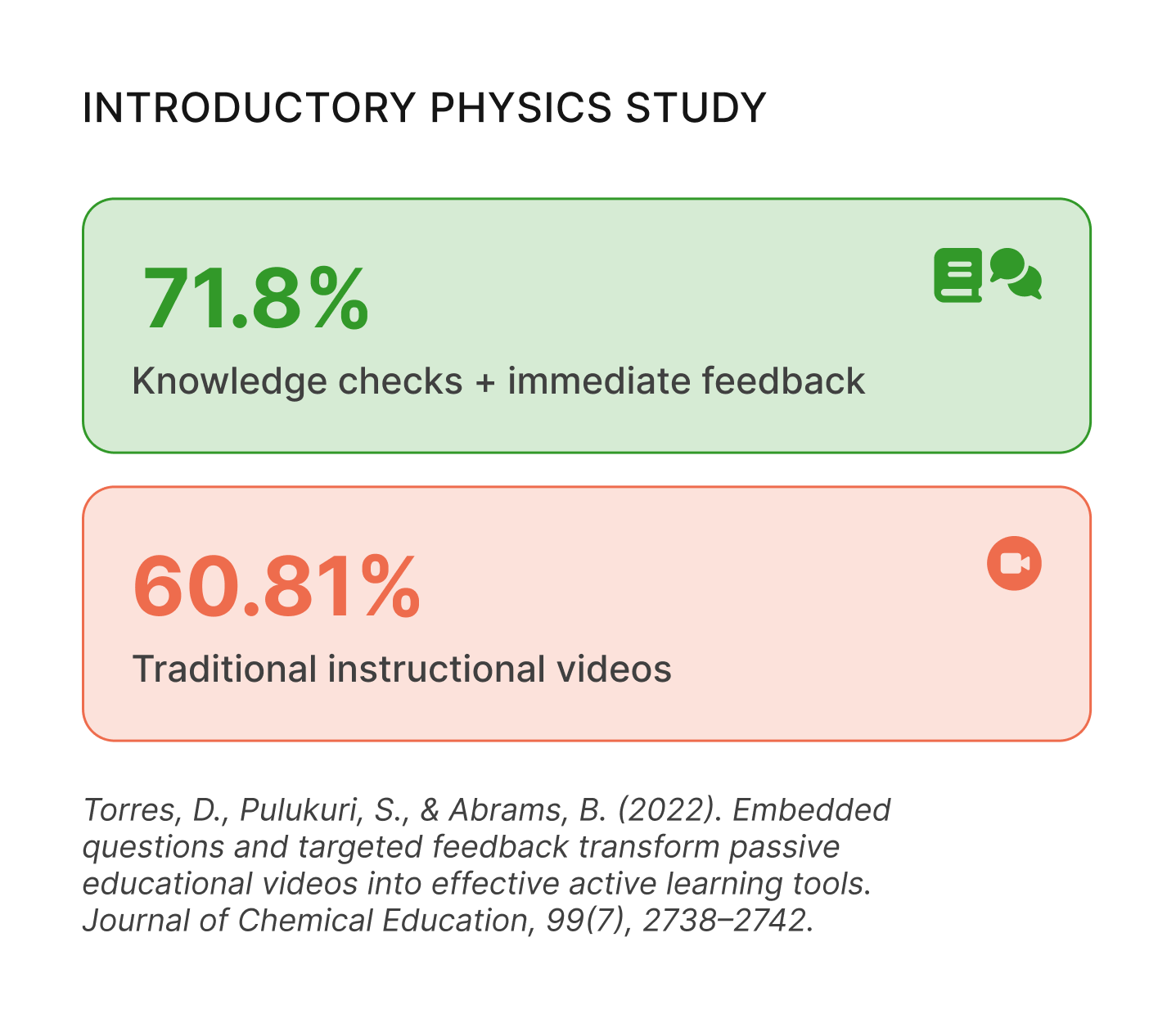
In a 2022 study published in the Journal of Chemical Education, Torres et al. found that students using instructional videos with embedded questions and targeted feedback achieved average assessment scores of 71.8%, compared with 60.81% for students watching traditional videos. The researchers attributed the stronger learning outcomes to the combination of active problem-solving and immediate feedback, which allowed students to check their understanding as they learned.
4. They support active participation in large and online classes
In a lecture hall with 150 students, asking for a show of hands won't reveal who actually understands a concept. A short digital knowledge check gives more students a way to respond, including the ones who'd rather not speak up in class. Instructors can then look at how students answered and decide whether to go back over a concept or keep moving.
10 Knowledge Check Examples for College Classes
Some knowledge checks just ask whether students remember a term. Others hand them a problem they haven't seen before and ask them to use it. The right one depends on what an instructor actually wants to know about the class that week.
When designing assessments, instructors often wonder what questions are on the knowledge test or how to structure effective knowledge check questions.
Try Our Free Research-Backed Assessment Redesigner
The ten examples below fall into three loose groups. Each has a sample question, and they're pulled from different fields on purpose.
Recall and comprehension checks
Applied checks
Interactive and reflective checks
Knowledge checks can be used anywhere. A question can be asked after a key paragraph in a reading or online module. A lecture video can pause midway and ask a question before letting students keep watching. A few questions can close out a class or a chapter. Professors can also use the microlearning approach with a follow-up question a week later so that students can refresh concepts they’re forgetting.
The goal should inform the format.
Using a standardized knowledge check template makes it easy for educators to build interactive prompts that help students check your knowledge throughout the lesson.
How to Create an Effective Knowledge Check
A well-built knowledge check tells an instructor which students are keeping up and which ones are lost without saying so. Moreover, it lets students fix their mistakes while their grade is not dependent on it.
Step 1: Start with the learning outcome
What's the lesson for? What should a student be able to do once it's over?
If it's evaluating an argument, a check that asks students to define the argument won't reveal much, since a definition can be memorized without any analysis at all. Have them find the weakest point in it and defend their choice
Match the question to the thinking in the objective. Recall usually isn't it, or at least isn't all of it. Bloom's Taxonomy is evolving, and course design and assessment are shifting along with it. If you're in the middle of that (and it's not an easy process), try our free Assignment Redesigner tool to get a head start.
Step 2: Pick a question format that fits
Formats aren't interchangeable, and it helps to know what each one is actually good at assessing.
Multiple choice and true/false are fast and good at flagging a misconception. Short answer and oral questions are slower. In exchange, students have to explain the concept in their own words and stand behind what they said. Scenarios and case studies test whether the idea is ready to be applied to a situation students have not encountered.
Be careful about the difficulty as well. Students should have to work a little, but not get overwhelmed with complexity unrelated to the concept. Where it's doable, ask for the reasoning along with the answer. Recognizing the right answer on a list takes a lot less time than producing it.
Step 3: Clear, focused, accessible
One knowledge check, one manageable objective. Long assessments wear students out, and a question that's secretly testing three unrelated ideas at once is not fair to learners
For a single focused concept, one to five solid questions is a reasonable place to start. More complex material might need more. Read it before assigning. Could a phrase be read two ways? Is an answer choice misleading? Is a question hard for no good reason? In a big course, try the questions on a couple of students or TAs first.
Don't forget accessibility. Screen readers and other assistive tech need to work with the questions, and a student who can't use one format should get another way to show what they know.
Step 4: Get the timing right
The end of the lesson is the default spot for a knowledge check. It isn't the only one. Right after a key concept, the idea is still fresh, and students can recall and put it to use.
Placement matters, and there's research on it. Wong et al. (2025) followed 183 undergraduates for 10 weeks. Some answered low-stakes questions embedded right inside instructional videos. Others answered the same questions after the video ended. The embedded group scored significantly higher on quizzes (p < .05) and participated more in the course (p < .001).
Marshall and Marshall (2021) found something along the same lines. Students who watched shorter video segments, with questions sitting closer to the content they covered, did better on knowledge checks and guessed less. The gap on the final post-test, however, was not statistically significant.
Checks can go after key sections of a reading, partway through a video, or right after a tough concept gets explained.
Step 5: Explain the answer, don't just mark it
"Incorrect" written in red letters doesn't teach a student much. Walk them through the reasoning instead. Name the misconception they most likely failed in, and show them where in the course to look.
Lewis et al. (2010) make the same split in their experiment. Some feedback only verifies whether the answer is correct. Explanatory feedback goes further and helps students understand the mistake itself. If possible, let students go back to the material and try a new question afterward. That way they can show they've actually understood it now.
Step 6: Let the responses shape what comes next
A batch of knowledge check answers is a preview of next week's lecture.
Look for the misconception that's spreading, the topic where students obviously need more attention. That concept needs reteaching, and probably with a new example, since the first explanation didn't work. Or maybe students perfected the definition and then fell apart applying it. More problem-solving is recommended then. Every so often the question itself is the problem. One that trips students up over and over might be badly worded, or might not match what was taught.
How Do Knowledge Checks Change in the Age of AI?
Knowledge checks are still useful for formative learning. Generative AI being a tab away hasn’t changed that. What it does change is how much a correct answer tells a professor. The answer can be right while saying almost nothing about how the student got there.
A student could turn in a perfectly accurate response and never have worked through the concept themselves. Trying to make every knowledge check impossible to answer with AI is futile. It’s more practical to design activities that ask students to show their reasoning.
Explore practical ways to make assessments AI-resilient
Three approaches help in particular.
- Ask students to explain their choices. Why did you choose B? Which principle makes it the right answer?
- Connect questions to specific course material. A chatbot does fine with generic questions. It’s the case study the professor assigned, or the example from their own field, that makes students go to the lesson to work out an answer.
Introduce brief oral knowledge checks. Ask a student to talk a concept through, and you hear things a written answer won’t show. It can demonstrate how they’ve organized the ideas, which ones they’ve connected, and how they answer a follow-up question nobody warned them about.
UIC’s teaching center agrees with this. Frequent low-stakes quizzes and knowledge checks are one of the things its 2026 guidance on adapting assignments for AI recommends for reinforcing learning.
Oral responses aren’t proof that a student never used AI. They are a practical and effective method to add a piece of evidence about student comprehension.
How Edvisor Makes Knowledge Checks Easier for Professors
Nobody argues against more frequent assessment in principle. The problem is writing every one of those knowledge checks, running them, and then going through the responses.
Edvisor builds the knowledge checks out of the professor’s own materials. That way, a few minutes of active recall does not become a new project for already burnt-out professors.
Edvisor's Knowledge Check can be a three-minute, ungraded oral activity that can be placed at the end of a reading. Students show understanding by responding aloud to these questions, which have adaptive follow-up questions.
The value of explaining one's reasoning is supported by research. In a randomized study involving 199 college students, Ryan and Koppenhofer (2024) found that prompted self-explanations improved initial learning compared with students' usual study methods, although they did not improve longer-term retention.
Similarly, a 2025 study involving 722 university students found significantly higher final assessment scores and overall course grades after interactive oral assessments were introduced (p < .0001). It wasn't a randomized experiment, so it can't prove cause and effect, but it's promising evidence for bringing oral assessments into university courses (Davey et al., 2025).
When teaching market segmentation, for example, Edvisor might ask a student why one particular customer group looks like an attractive target market. Then, depending on the answer, a follow-up: what assumption would have to change for that decision to change too?
The student has to put their reasoning into words. There's no correct option to pick from a list.
How does Edvisor compare with other knowledge check tools?
Edvisor's checks are short, spoken, and drawn from whatever the course assigned that week. Here’s how it compares to other options available to professors.
Knowledge checks are the lightest option. Edvisor offers four levels of oral assessment in all:
- Knowledge Check: three minutes, no grade, right after a reading.
- Oral Quiz: spoken questions on anywhere from one to three chapters.
- Oral Exam: longer, covering several chapters, with follow-ups that adapt.
- Oral Defense: students explain written work they've turned in.
Stephenson et al. (2025) looked at 24 studies on oral assessment in a systematic review. What seemed to help students perform was structured practice, timely feedback, and self-reflection.
So instructors can use Edvisor to run quick oral knowledge checks all semester, and hold the bigger assessments back for measuring the broader outcomes of the course.
Assess Understanding Without Adding Another Grading Burden
Knowledge checks are most useful when they become a natural part of learning. Students can learn from these low-stakes tests, and professors can get a clear picture of how well the class understands the course. In the age of AI, they can also encourage students to do something that a graded take-home assignment can’t show.
With Edvisor's course-aligned readings and three-minute oral Knowledge Checks, professors can build these opportunities into the learning experience without turning every chapter into another graded exam.
References
- Chan, J. C. K., Ahn, D., Szpunar, K. K., Assadipour, Z., & Gill, H. (2025). In-lecture quizzes improve online learning for university and community college students. Communications Psychology, 3(1), Article 54. https://doi.org/10.1038/s44271-025-00234-5
- Chen, K.-F., Hwang, G.-J., & Chen, M.-R. A. (2024). Knowledge check-based concept mapping in digital games: Impacts on students’ learning performance and behaviors. Educational Technology Research and Development, 72, 2297–2324. https://doi.org/10.1007/s11423-024-10378-6
- Torres, D., Pulukuri, S., & Abrams, B. (2022). Embedded questions and targeted feedback transform passive educational videos into effective active learning tools. Journal of Chemical Education, 99(7), 2738–2742. https://doi.org/10.1021/acs.jchemed.2c00342
- Lewis, D., Trail, T., Srinivasan, S., Lee, S. J., & Lopez, S. (2010). Knowledge check questions: Best practices for use of this instructional strategy. In J. Herrington & C. Montgomerie (Eds.), Proceedings of ED-MEDIA 2010—World Conference on Educational Multimedia, Hypermedia & Telecommunications (pp. 2783–2788). Association for the Advancement of Computing in Education. https://www.learntechlib.org/p/35034/
- Marshall, F. B., & Marshall, J. (2021). The effects of embedding knowledge-check questions in instructional videos. Journal of Interactive Learning Research, 32(4), 281–294. https://eric.ed.gov/?id=EJ1363547
- Wong, J. T., Richland, L. E., & Hughes, B. S. (2025). Immediate versus delayed low-stakes questioning: Encouraging the testing effect through embedded video questions to support students' knowledge outcomes, self-regulation, and critical thinking. Technology, Knowledge and Learning, 30, 1421–1456. https://doi.org/10.1007/s10758-024-09746-1
- Davey, S. K., Birbeck, D., Nallaya, S., Sallows, G., & Della Vedova, C. B. (2025). Utilising one-on-one interactive oral assessments as the major final assessment within a bioscience course. Assessment & Evaluation in Higher Education, 50(7), 1154–1171. https://doi.org/10.1080/02602938.2025.2502577
- Ryan, R. S., & Koppenhofer, J. A. (2024). Prompted self-explanations improve learning in statistics but not retention. Teaching of Psychology, 51(4), 402–413. https://doi.org/10.1177/00986283221114196
- Stephenson, Z., Johnson-Glauch, N., & Cruchley, S. (2025). Interventions and facilitators of oral assessment performance in higher education: A systematic review. Assessment & Evaluation in Higher Education, 50(7), 1140–1153. https://doi.org/10.1080/02602938.2025.2504621
Frequently Asked Questions
What is another word for a knowledge check?
A knowledge check is also known as:
- Learning checkpoint
- Progress check or pulse check
- Self-assessment
- Check for understanding
Are practice questions the same as knowledge checks?
Practice questions and knowledge checks serve similar purposes in learning, so they can be confusing for someone designing a course. They are, in fact, different in how and when they're used in a course.
How to write knowledge check questions?
Writing effective knowledge checks requires careful design. The prompts should be low-stakes and ungraded. They should test understanding rather than memorization. They should also reinforce what students learn so they retain it. Finally, they should include detailed feedback that re-teaches the material instead of simply assigning a grade. Here’s five points to guide your process:
- Align with learning objectives
- Prioritize application over recall
- Vary question formats
- Explain every answer choice
- Keep checks short, paced


