

How to Deliver Effective Feedback for Students
Apply best practices of effective feedback delivery to help students reflect and improve at the right time.


Feedback for students
Feedback is one of the most useful things a professor can give a student, but it is also one of the easiest things to rush. A thoughtful comment takes time. Multiply that across 50, 100, or 200 students, and even good intentions can turn into delayed and vague feedback that students barely use. The challenge is to make it useful without making the workload impossible for instructors.
What Is Feedback?
Feedback is the information students get about their work with respect to the goals of the course. At its best, it does a lot more than tell students whether an answer was right or wrong. It shows them where things are starting to fall apart, and how they can adjust their next attempt.
That matters quite a lot. Feedback is supposed to point students somewhere. It can draw attention to gaps in learning and highlight what is already working well. Yes, there is usually some evaluation involved, even if nobody is attaching a grade to it, but good feedback should leave a student with more than a judgment. They should have something useful they can actually do with it.
It might comment on:
- the final result of an assignment
- the steps a student took to get there
- or how they adjusted their learning.
Feedback for students should be impersonal and comment on the work or approach. For example, “Great job!” might feel nice, but it gives a student very little to work with on the next assignment.
Why Is Feedback Important for Students?
A grade can tell a student where they ended up but feedback guides them where their reasoning held together and where it started to wobble. This helps them understand how to move forward.
Research supports that connection. In a 2026 study of 355 secondary-school students, quality feedback was a significant predictor of mathematical problem-solving ability. A one-standard-deviation increase in feedback quality was associated with a 0.213 standard-deviation increase in problem-solving skills. It also made feedback the strongest of the three instructional factors examined (Davor et al., 2026).
Timing matters here too when providing feedback to students, and probably more than we admit. Feedback that arrives after students have mentally moved on from an assignment is much harder to use. There is another side to this, though. Park et al. (2024) found that students expected positive feedback to have a greater effect than objective-only feedback in both mathematics and English courses. So this is not really an argument for more praise. Feedback just needs to have good framing and tone for effectiveness. We'll explore in this article what can help you get there.
Explore practical ways to make assessments AI-resilient
Types of Feedback
In the educational and instructional sphere, there are two types of student feedback:
Formative feedback
- Happens during the learning process
- Usually lower stakes
- Helps students catch mistakes early
- Gives students a chance to improve unfinished work
Summative feedback
- Happens at the end of a course or learning period
- Evaluates final learning outcomes
- Measures student performance against established standards
Qualities of Effective Feedback
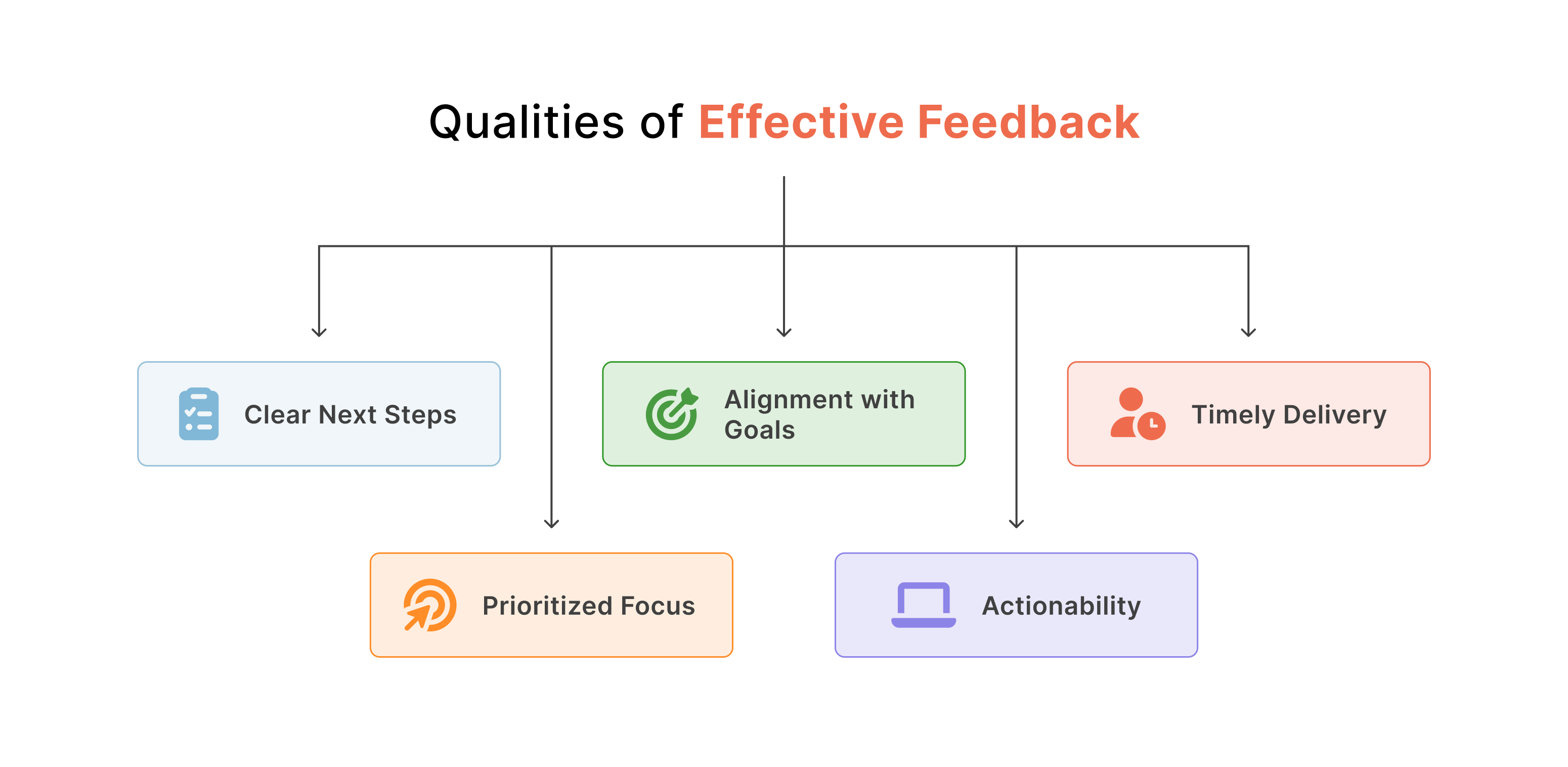
Good feedback has a simple rule: it should make the next step obvious to the student. Sometimes it is technically perfect, but it has no route for the student to begin fixing their ideas. Feedback completely misses its point if there is no clarity regarding this.
A long list of mistakes can overwhelm them. Every comment seems equally important then. A better approach is to identify two or three major areas where improvement would make the biggest difference. It makes the students' work more manageable.
It should be focused on the goals of the assignment, too. Comments are easier to act on when they connect directly to the skill or learning outcome being assessed. Feedback such as “develop this point further” is fairly vague. Telling a student that their evidence does not yet support the argument - and pointing to where that happens - gives them a much clearer place to start.
Then there is actionability. Students need more than a description of what went wrong. They need some direction about what to do next. Ruwe and Kuklick (2026) found that university students rated high-quality feedback more positively than lower-quality feedback, regardless of whether they thought it came from an educator or an LLM. In their study, higher-quality feedback included explanations, worked examples, and references to the student’s text rather than a simple evaluation alone.
And timing still matters. Students should have time to apply it before the work is finished. One learning cycle should have several low-stakes opportunities for them to test a new approach if they make a mistake.
One striking finding from Ruwe and Kuklick (2026) was that students cared more about the quality of the feedback than who - or what - produced it: labeling identical feedback as coming from an educator or an LLM did not significantly change how students rated the feedback itself (p = .831).
Effective Feedback Strategies
The following practices help make feedback more focused and actionable:
- Use rubrics: Define the different levels of assessment performance. Professors create rubrics based on learning objectives.
- Focused and simple: Not everything in the student's assignment needs to be dissected. Identifying two or three large areas of improvement and appreciating a little can go a long way. Some good examples are,
- “Your analysis identifies the key issue, but the connection to the course concept needs to be made more explicit.”
- “Your sources are relevant, but the discussion relies too heavily on summary rather than analysis.”
- “Your interpretation is promising, but you need to address the strongest counterargument before reaching your conclusion.”
- Regular feedback: Frequent, low-stakes practice tests create a culture of feedback. If they’re not actively reflecting on the feedback, they’re not implementing it comfortably.
- Timing: It’s important to give feedback while the student is still learning. Rushed feedback at the end of the semester can help very little.
- Mode of delivery: Besides written feedback, teachers can have conversations or facilitate student-to-student feedback. Professors can also experiment with less traditional feedback spaces. Reddit, for example, has been used in academic settings to support authentic learning, critical thinking, information literacy, and collaborative discussion (LaFlamme, 2025).
- Ask for feedback on your feedback: Invite students to explain how they understood your comments and what would help them act on them. Listening to their responses can reveal unclear advice and help you improve your own feedback practices (LeBourdais, 2023).
Writing Feedback for Students
As we’ve seen, students should encounter criteria early. That’s how they can use them to review their own and others’ work, and receive feedback at a point where it can still change what they do. We’ve created some ready-to-use prompts for you to start the process.
3 Feedback Templates Professors Can Use
Peer and Self-Assessment of Group Contributions
This is useful for any course with group projects. Students evaluate their own contribution and give constructive feedback on their peers’. It can make individual effort more visible, and professors can see that as well when evaluating each student's effort. It’s the ideal method to combine peer feedback with reflection rather than leaving group performance as one shared grade.
Ready-to-use template:
- What did this group member contribute effectively?
- Where could their contribution improve?
- How would you assess your own contribution using the same criteria?
- What is one change you would make in the next stage of the project?
Mid-Project Team Performance Evaluation
This one is especially useful because the feedback happens before the project is finished. Students assess their team using a structured rubric. The original template is intended to encourage early reflection and guide improvements as the project continues.
Ready-to-use template:
- What is the team doing well so far?
- Where is the team getting stuck?
- Rate communication, reliability, contribution, and collaboration.
- What should the group change before the final submission?
- What will you personally do differently during the remaining work?
Revision, Peer Critique, and Reflection
The reflection template is aimed at essays, but could work for reports, proposals, case analyses, or other written assignments. Students give and receive peer feedback and then revise their work, so feedback becomes part of the assignment. PAIRR (Peer + AI Review + Reflection), developed at UC Davis and presented by Anna Mills, offers a structured approach. Students gather peer and AI feedback on their own drafts, compare the suggestions, and explain which advice they’ll use or reject before revising. The goal is to exercise judgment, rather than simply follow the AI’s recommendations (Mills, 2026).
Ready-to-use template:
- What is the strongest part of this draft?
- Where does the argument or explanation need more support?
- What is one concrete revision the writer could make?
- After receiving feedback: Which suggestion did you use, and why?
- What changed between your first and final version?
- Where did peer and AI feedback differ, and why did you choose one suggestion over another?
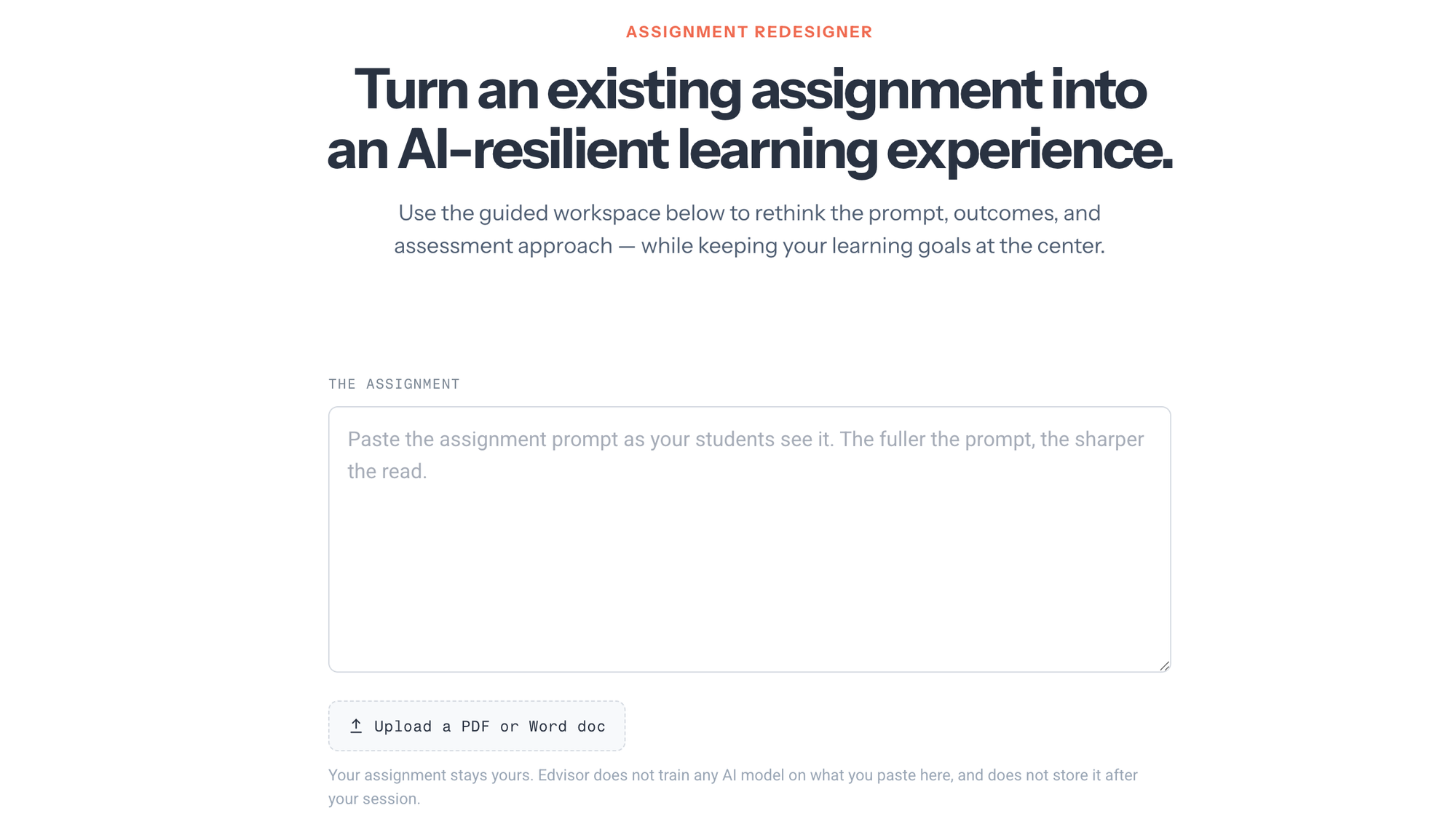
Try Our Free Research-Backed Assessment Redesigner
How to Provide Feedback to Students
Here’s a quick feedback reflection matrix for Instructors so they can see if the purpose of feedback is fulfilled.
Implementing all this for a class of 100 students can be incredibly challenging. Banihashem et al. (2025) argue for hybrid intelligent feedback, where AI can provide timely feedback and scalable support while the teachers stay involved for context and interpretation. Their framework stresses complementarity, iterative refinement, adaptability, personalization, and shared agency rather than treating AI feedback as a replacement for instructors (Banihashem et al., 2025). Edvisor uses the instructors' rubrics and course materials in its AI coursepacks for the same reason. Let’s look at some of the most useful features of Edvisor that aid professors in delivering feedback that helps students. Teacher feedback on student writing is especially difficult as AI has made it very easy to form sentences, and teachers can pick up on nuances that detectors can’t.
How Edvisor Helps You Implement Effective Feedback Strategies
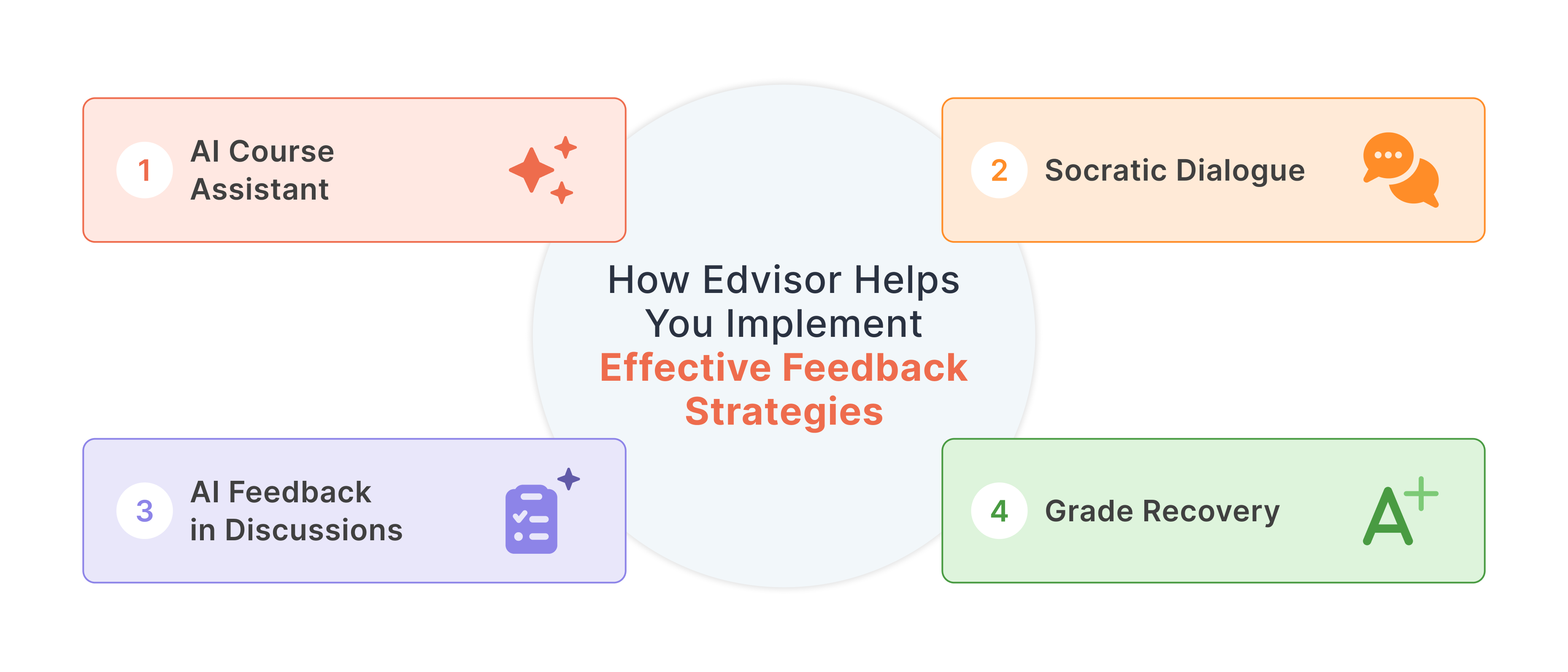
Edvisor brings feedback into different parts of the learning process. The platform is designed on active learning principles so they receive it while students are working through course content and responding to activities. Research on AI-supported feedback is increasingly showing benefits here. A 2026 meta-analysis of 85 studies involving 9,564 students found a significant, medium-sized positive effect of AI feedback for students on self-regulated learning, g = 0.509, p < .001, 95% CI [0.404, 0.613] (Huang et al., 2026). The effects were strongest for motivation (g = 0.613) and cognition (g = 0.478).
Edvisor’s own Fall 2025 student survey points in a similar direction. Among 452 respondents across 36 universities, 83% said Edvisor improved their engagement and 83% said it improved their understanding of course material.
AI Course Assistant
The AI Course Assistant is available 24/7 as students consume course content. Students can ask questions at the point where confusion comes, and they don't carry that confusion into the last exam of the semester.
Huang et al. (2026) found that AI feedback had stronger effects on the motivational and cognitive dimensions of self-regulated learning than on behavioral and metacognitive outcomes. Generative AI dialogue systems were also among the AI types associated with stronger effects. Edvisor’s survey data suggests students value this kind of in-the-moment support too. 39% said clearer understanding was one of the main reasons Edvisor helped them learn, 11% named AI Chat within Edvisor as their favorite feature, and another 9% selected readings with the AI tutor.
Socratic Dialogue
Sometimes students need another question more than they need the answer. Edvisor uses Socratic Dialogue during readings and during Grade Recovery, prompting students to work through their reasoning rather than simply receiving a correction.
A randomized controlled trial provides some relevant evidence for this approach. Lu et al. (2026) studied 354 undergraduate economics students using an AI-mediated feedback system in which teaching assistants could adopt, edit, or reject AI-generated feedback suggestions. Students receiving the AI-mediated feedback produced stronger revisions than students receiving human-only feedback, with an effect of approximately Cohen’s d = 0.50 (Lu et al., 2026).
The study used feedback that pointed students toward gaps in their work through questions and guidance rather than simply supplying the answer. It is not a direct evaluation of Edvisor’s Socratic Dialogue, but it provides evidence for the broader instructional approach of using AI-supported questioning to guide revision.
Edvisor’s own student comments reflect a similar preference for iterative feedback. One student described valuing the chance to receive instant feedback, ask a follow-up, and explain their reasoning further instead of simply getting something wrong and moving on.
AI Feedback in Discussions
Edvisor discussions give students AI feedback on their responses to discussion topics. That creates another feedback point during the course when students are developing an argument or explaining their thinking. Giving students AI feedback is not automatically enough. Students still need to judge what they receive and decide what to do with it.
Zhan and Yan (2026) make that especially clear. Their study followed 16 university students as they worked with ChatGPT feedback on writing tasks. Students frequently acted on the feedback, but their engagement tended to be stronger at the cognitive level and weaker at the metacognitive level; behavioral engagement was often limited to a single interaction (Zhan & Yan, 2026). A separate review of the study reports that 56.3% of revisions directly adopted ChatGPT’s suggestions, particularly for local changes such as grammar (Zhan & Yan, 2026).
AI feedback can give students another opportunity to reconsider their work, but students still need practice evaluating that feedback rather than accepting every suggestion automatically.
Grade Recovery
Grade Recovery gives students another opportunity to act on feedback rather than simply seeing a grade and moving on. During the process, Socratic Dialogue can prompt students to revisit their thinking and work through where they went wrong.
Grade Recovery was the most commonly selected favorite feature, chosen by 29% of students. Students who selected it as their favorite reported an average perceived grade lift of 9.1 percentage points. Lu et al. (2026) found better revision outcomes when AI-assisted feedback was incorporated into the revision process rather than functioning only as an end-stage judgment.
Start Optimizing Feedback Delivery Mechanisms
Good feedback should do more than explain what happened on an assignment. It should give students a clear next move and enough time to use it. Faculty can support real learning through these considerations. Edvisor is built around that idea, with feedback woven into readings, discussions, AI support, and Grade Recovery, and not just saved for the end. If you want feedback to become part of how students learn, see how Edvisor works in a course.
Frequently Asked Questions
What Kind of Feedback Is Most Useful?
For feedback to be impactful, teachers should make sure it’s delivered on time and gives easily actionable steps for improvement. The more precise it is, the better!
How Do I Write Constructive Feedback for Students?
The feedback should be rooted in the rubrics designed by the teacher. To make it constructive, give some positive motivation for the student to reflect.
Why Is Immediate Feedback Important?
Real-time feedback makes students see which of their concepts are correct and which need to be corrected. To read about its efficacy, read our blog about immediate feedback.
References
- Davor, I., Asare, C., & Abanamu, A. (2026). Predictors of students’ mathematics problem-solving skills: Feedback, beliefs, learning support, and technology. Sustainable and Pedagogical Technologies, 2(2), Article e43735. https://doi.org/10.33902/SPT.202643735
- Park, L. E., Ward, D. E., Moore-Russo, D., Rickard, B., Vessels, V., & Hundley, J. (2024). Positive feedback as a lever to boost students’ STEM outcomes. Personality and Social Psychology Bulletin. https://doi.org/10.1177/01461672241265954
- Ridgway, L. M., Davies, A. W., McNamara, G., Hayes, B., & Morris, C. (2026). Feedback for learning in the engineering disciplines. In G. Saunders-Smits, L. Van den Broeck, & T. Johannsen (Eds.), SEFI handbook on teaching transferable competencies and skills in engineering (pp. 277–297). TU Delft. https://doi.org/10.59490/mt.266.67
- Ruwe, T., & Kuklick, L. (2026). Quality counts? Examining the role of feedback provider and feedback quality on students’ feedback perceptions. British Journal of Educational Technology, 57(1), 272–298. https://doi.org/10.1111/bjet.70011
- LaFlamme, K.A. Leveraging Reddit in academia. Discov Educ 4, 163 (2025) https://doi.org/10.1007/s44217-025-00542-2
- Huang, C.-Q., Lu, L.-N., Huang, Q.-H., Zhang, Y.-R., He, T., Tu, Y.-F., & Hwang, G.-J. (2026). Effects of artificial intelligence feedback on students’ self-regulated learning in higher education: A three-level meta-analysis. Educational Psychology Review, 38. https://doi.org/10.1007/s10648-026-10166-z
- Wang, W., Wang, Y., Chen, J., Wang, X., Zhang, H., Guo, C., & Peng, Y. (2026). The effectiveness of AI-supported personalized feedback on students’ learning outcomes and motivation: A meta-analysis. Journal of Educational Computing Research, 64(3), 724–755. https://doi.org/10.1177/07356331251410020
- Zhan, Y., & Yan, Z. (2026). Students’ engagement with ChatGPT feedback: Implications for student feedback literacy in the context of generative artificial intelligence. Assessment & Evaluation in Higher Education, 51(5), 821–834. https://doi.org/10.1080/02602938.2025.2471821
- Banihashem, S. K., Noroozi, O., Khosravi, H., Schunn, C. D., & Drachsler, H. (2025). Pedagogical framework for hybrid intelligent feedback. Innovations in Education and Teaching International. https://doi.org/10.1080/14703297.2025.2499174
- Mills, A. (2026, July 28). Integrating AI Feedback with the PAIRR Model and Considering AI Guardrails [Presentation for CUNY AIGE Fellows]. Presentation link. Relevant slides: 4–5 and 23.
- LeBourdais, G. P. (2023, September). Great Work: Why Feedback is so Important for Students and How to Make it More Effective. Polygence. Relevant pages: 10 and 17–18.


